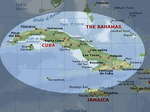
"We've never had a worst foreign policy, trade policy or even an international policy than what we have with Cuba....It is shameful that you think that six people should dominate our trade and foreign policy with any country." --Rep. Charles Rangel
Clash Over Cuba
Wolf Blitzer
3 October 2007
CNN: The Situation Room
UNIDENTIFIED MALE: We've never had a worst foreign policy, trade policy or even an international policy than what we have with Cuba.
(END VIDEO CLIP)
BLITZER: Is it time to lift the embargo or is Fidel Castro finally on the ropes? You're going to hear two very different views.
....
Stay with us. You're in THE SITUATION ROOM.
A congressman makes a powerful case for the U.S. to keep the heat on Cuba.
(BEGIN VIDEO CLIP)
UNIDENTIFIED MALE: You have a dictator who is on his deathbed and who has had absolute and total power for almost 50 years.
(END VIDEO CLIP)
BLITZER: We're going to have a red-hot discussion about Castro's Cuba and whether it's time for the U.S. to lift sanctions and travel restrictions.
....
I'm Wolf Blitzer. You're in THE SITUATION ROOM.
As part of CNN's uncovering America series, we're taking a closer look at some of the issues affecting the Latino community. Many Hispanic Americans have very definite and diverse opinions about U.S. policy toward Cuba. And so does the United States Congress. Some lawmakers insist the time is right to ease sanctions against the communist nation. Others say that would be a huge mistake. And joining us now Democratic Congressman Charlie Rangel of New York and Republican Congressman Lincoln Diaz-Balart of Florida; gentlemen thanks very much for coming in.
And Charlie Rangel, let me start with you. You're the more senior member of this panel. Why do you believe it's time now to go ahead and lift the restrictions, lift the embargo, try to normalize relations with Cuba?
REP. CHARLES RANGEL (D), NEW YORK: It was the time 45 years ago. The truth of the matter is that we have farmers anxious to sell chickens and pork and rice and beans and open up the markets. And so it's good for our farmers. We have a restriction on the fact that Cuban Americans and others cannot visit Cuba. This has been for over 40 years. We cannot even -- they can't send money to try to help their relatives in Cuba. And, lastly, they can only visit once every three years. So, if they have a relative that's dying, they've got to time the death. This policy is really cut out for a handful of people in Miami and it's the tail wagging the dog. We've never had a worst foreign policy, trade policy or even an international policy than what we have with Cuba.
BLITZER: All right, Congressman Lincoln Diaz-Balart, why do you disagree?
REP. LINCOLN DIAZ-BALART (R), FLORIDA: Well Mr. Rangel first misstated some of the details of our policy. But let's focus on the principle aspects here. First of all, we are keeping billions of dollars from that communist terrorist dictatorship. And I'm sure that the family of Sergeant Greg Fronius, who was killed in El Salvador in 1987 by a Cuban planned mission, a Green Beret who was training the Salvador armed forces at the time or our forces who were killed fighting the Cubans in 1983, when our forces invaded and liberated Grenada, the relatives of those killed I'm sure would agree that it's a good idea to keep billions and billions of dollars from that communist terrorist dictatorship.
When that regime had $6 or $7 billion a year from the Soviet Union, precisely -- Angola, Nicaragua and El Salvador, and so many other places, were hit with direct terrorism from that regime.
BLITZER: All right...
DIAZ-BALART: So we're keeping billions of dollars from that regime.
And then, now that the dictator is finally on his death bed, it's important that we retain...
BLITZER: All right...
DIAZ-BALART: ...leverage so that the political prisoners -- that's what we're -- that's what our policy says.
BLITZER: Well (INAUDIBLE)...
DIAZ-BALART: ...the embargo goes away tomorrow if all political prisoners -- and when all political prisoners are freed; political parties, labor unions and the press are legalized; and free elections are scheduled. Which of the three conditions do the Cuban people not deserve?
BLITZER: All right, Congressman Rangel?
RANGEL: Let me tell you one thing. First of all, he never said that Cuba or Castro has killed anybody. Indeed, the record is clear that we tried to kill him. But when he starts talking about...
DIAZ-BALART: How about the brothers to the rescue who were murdered over international space?
Didn't Castro kill them?
RANGEL: Let me talk about communists. You know, you try...
DIAZ-BALART: What were -- how about that Vietnam veteran killed by Castro in 1995?
RANGEL: Could I -- could I finish?
DIAZ-BALART: No, no...
RANGEL: Let's talk about...
DIAZ-BALART: ...but you said that Castro hasn't killed anybody.
RANGEL: Castro...
DIAZ-BALART: How could you say that...
RANGEL: Let me tell you...
DIAZ-BALART: ...when a Vietnam veteran was killed by Castro...
RANGEL: Please, don't be..
DIAZ-BALART: ...in 1996?
RANGEL: Please, don't be. You can be emotional, but don't be rude. The fact is that we do business with Vietnam and they're responsible for at least 60,000 Americans being killed. We do business with North Korea and China -- tens of thousands of Americans that are have been killed. So we do business with Vietnam, with North Korea, with China -- and he's going to tell me that we should be fearful of the communist, Castro? It's absolutely ridiculous. It is true that Castro had no business shooting down pilots that were flying over Havana, violating all of American laws...
DIAZ-BALART: ...the international air space.
RANGEL: They were unarmed so and he shouldn't have shot them down. But the truth is they shouldn't have been flying over Cuba in the first place...
DIAZ-BALART: They (INAUDIBLE)...
RANGEL: ...according to our laws.
DIAZ-BALART: When they were shot down, there were shot down...
RANGEL: Well, there's...
DIAZ-BALART: ...and it was...
RANGEL: Whatever.
DIAZ-BALART: ...it was over international air space.
RANGEL: I agree with you.
DIAZ-BALART: Secondly...
RANGEL: But tens of thousands of Americans...
DIAZ-BALART: Yes...
RANGEL: ...have been killed by communists that we do billions of dollars of business with.
DIAZ-BALART: Yes.
RANGEL: And you're going to tell us that we should...
DIAZ-BALART: And the same...
(CROSSTALK)
BLITZER: Congressman Lincoln Diaz-Balart, let me just...
(CROSSTALK)
BLITZER: Let me just point out...
DIAZ-BALART: Yes?
BLITZER: ...that not only does the United States do billions of dollars worth of business with these other communist regimes, but it is now seeking most favored nation trading status for a lot of them, as well.
DIAZ-BALART: Well, first of all, every -- every instance and every geographical and historical situation in the world, obviously, merits a particular policy. I happen to disagree with our policy of enriching the communist regime in China. I think we're going to regret that in 10 or 20 years. But what we're talking about right now is that we have people in prisons because of their beliefs in Cuba -- 90 miles away from the United States. It's one of a handful of remaining states that are classified as state sponsors of terror. And you have a dictator who is on his death bed and who has had absolute and total power for almost 50 years.
BLITZER: All right...
DIAZ-BALART: And what our policy is saying is liberate all political prisoners, legalize political parties and the press and labor unions...
RANGEL: OK...
DIAZ-BALART: ...and schedule free elections. And the question is, obviously, when that personal -- absolute personal totalitarian dictator disappears from the scene...
RANGEL: OK...
DIAZ-BALART: ...it's going to be -- and is finally approaching...
BLITZER: All right...
DIAZ-BALART: ...it's going to be critical...
BLITZER: Go ahead.
DIAZ-BALART: ...for those political prisoners...
RANGEL: OK...
DIAZ-BALART: ...to have that leverage for a democratic transition.
RANGEL: OK. You're repeating yourself. The fact of this is that the embargo has not proven to be effective. We and Israel are the only ones that respect the embargo. Every other country is doing business with them. And I'm telling you, the people in Florida -- your constituents who want to visit, who want to send money to their parents to help them out -- you are not telling me that by punishing them that you're helping to get rid of this Castro dictator.
BLITZER: Well, hold on.
RANGEL: I can't believe that. (CROSSTALK)
DIAZ-BALART: First of all, with regard...
BLITZER: Congressman Lincoln Diaz, I want you to respond to that. But also respond to Senator Barack Obama, the Democratic presidential candidate. He wrote recently in "The Miami Herald," he wrote this. He said: "Cuban-American connections to family in Cuba are not only a basic right in humanitarian terms, but also our best tool for helping to foster the beginnings of grassroots democracy on the island. Accordingly, I will grant Cuban-Americans unrestricted rights to visit family and send remittances to the island."
A lot of Cuban-Americans in Florida and elsewhere, congressman, would like that.
DIAZ-BALART: It's interesting, Wolf, because we are six Cuban- American members of Congress -- four Republicans, two Democrats; four members of the House, two senators. And we have great disagreements on partisan issues, as you can imagine. On the issue of Cuba -- and, obviously, we represent the overwhelming majority of Cuban-Americans, the six of us. We represent the overwhelming amount of Cuban-Americans in the country. And we face, obviously, our constituents every two years at the polls. The six of us -- the Cuban-Americans of both parties -- are one on the issue of Cuba.
So if you talk to any of the six of us -- and, obviously, we represent the overwhelming majority of Cuban-Americans and those people who Mr. Rangel now -- and Mr. -- as Mr. Obama now in his -- the -- that piece that he wrote that you mentioned, Wolf -- they seem to be so concerned about. It's the six of us...
BLITZER: All right...
DIAZ-BALART: ...who represent the overwhelming majority of them. And we are -- from both parties -- totally united in saying that until the political prisoners are released.
RANGEL: It's shameful.
DIAZ-BALART: And political parties -- and it's -- no, and what's shameful is to not stand with the Cuban people and their right to free elections.
RANGEL: It is shameful to think that six...
DIAZ-BALART: Now, now, now, now, now...
BLITZER: Hold on. Hold on. Let Charlie Rangel...
DIAZ-BALART: Now, now, I think...
BLITZER: Let Charlie Rangel respond. Go ahead.
RANGEL: It is shameful that you think that six people should dominate our trade and foreign policy with any country. I don't care what your background is, it has to be what's in the best interests of the people of the United States and not what's in the best interests of your constituents...
DIAZ-BALART: And what I...
RANGEL: ...who violently oppose what you're doing.
DIAZ-BALART: Oh, oh, oh, oh...
RANGEL: But it's shameful that you would say that our secretary of state, our president, our trade representative -- to go to four Cuban-Americans in the House to dictate America's policy. That is constitutionally and morally wrong.
DIAZ-BALART: Well, you know, what's interesting is that we hear so many arguments here.
Number one, that our constituents disagree with us. I think there will be...
RANGEL: Yes.
DIAZ-BALART: Very well. Who are the constituents who can vote for us, the six of us?
So, if that's the case, then it would seem that every two years our constituents, being in such disagreement with us, it would be manifested at the polls.
RANGEL: No...
DIAZ-BALART: Number two...
RANGEL: I think that...
DIAZ-BALART: Number two...
RANGEL: I think that probably...
DIAZ-BALART: Number two, please...
RANGEL: That probably...
DIAZ-BALART: Please, let's not...
RANGEL: That probably...
DIAZ-BALART: Please let's not be -- talking about rudeness. Please, if you could have...
RANGEL: That probably is going to happen.
DIAZ-BALART: If you can give me a chance to speak.
RANGEL: OK.
(INAUDIBLE).
DIAZ-BALART: With regard -- as I started saying -- as I started saying when we started this -- this conversation, when the regime in Cuba had an equivalent amount of what it would receive only from mass U.S. tourism alone -- which was $6 or $7 billion a year, what did that terrorist regime do? It killed our G.I.s in Grenada. It killed Sergeant Fronius in El Salvador. It sponsored terrorism throughout this hemisphere and much of the world.
So...
BLITZER: All right...
DIAZ-BALART: ...you'd better believe that it's in the interests of the United States to deny billions of dollars from a regime and have a policy that calls for free elections and the liberation of all political prisoners...
BLITZER: All right...
DIAZ-BALART: ...in a country that's 90 miles away.
BLITZER: Well, we're...
DIAZ-BALART: It is in the interests of the United States to not fund a terrorist regime 90 miles away.
BLITZER: Lincoln Diaz-Balart and Charlie Rangel debating here in THE SITUATION ROOM.
[1) Family remittances are still permitted, but they are limited in amount and in recipient, i.e. now they can only go to immediate family members such as parents, children, not aunts, uncles, nephews, nieces, etc. I think grandparents and grandchildren are also OK.
2) Israel votes with the US at the UN in support of the embargo. but they don't participate in it. The largest citrus operation in Cuba is Israeli managed (by the former head of Israeli intelligence) and Israelis are big investors in property development.
3) Regarding Diaz-Balart’s claim that the US must abide by the position of the six Cuban Americans in Congress, a recent Florida International University poll suggests they do not represent their constituents on this issue. Moreover, if the US had waited for Chinese Americans and Vietnamese Americans to agree, we would still have trade embargoes and no diplomatic relations with either country. Misleading and self-interested Iraqi exile politics contributed to the disaster there just as obeisance to the views of hard line Cuban Americans damage the US reputation in the rest of Latin America. –John McAuliff]
Sunday, October 7, 2007


Neo conservative Magazine Article Favors End of Family Travel Restrictions
After Fidel
With Castro fading fast, it's time to rethink U.S. policy toward the Cuban regime and give hope to a beleaguered people.
by Mario Loyola
Weekly Standard 10/15/2007, Volume 013, Issue 05
Commerce Secretary Carlos Gutiérrez, who fled the Cuban Revolution at the age of six in 1960, is the Bush administration's point man on Cuba policy. He is often asked whether the U.S. embargo is working. "My answer is an emphatic yes," he recently explained. "The embargo has denied Castro resources." Maybe so. But it has also supplied the Castro regime with two things it vitally needs: isolation and a foreign enemy who is not a real threat.
For decades the United States has maintained a policy of complete ostracism of Cuba--no travel, no trade, no remittances, no diplomatic relations. This has not cut the Castro regime off from resources: Cuba receives as much aid from Venezuela's Hugo Chávez as Israel gets from the United States. The policy has accomplished little except to protect the Castro regime from the outside influences that proved fatal to communism in Europe. And it is increasingly poisonous to the interests of the United States.
President Bush gave a clue to why this policy survives in his 2007 State of the Union speech when he said, "We will continue to speak out for the cause of freedom in places like Cuba, Belarus, and Burma." Miami representative Ileana Ros-Lehtinen gave the president a beaming thumbs-up, not stopping to think that what defines these three countries as a group is not the repressiveness of their governments (he could then have mentioned China or Saudi Arabia) but rather their strategic irrelevance.
Few Americans are old enough to remember that Cuba was once modern and vibrant, a powerhouse of cultural influence. Modernity was the reason for the revolution. Castro's initial base of support was among the urban middle class--university students, professionals, and small-business owners who wanted democracy. What they got was a cataclysm.
WASHINGTON REACTS TO CASTRO
The current U.S. policy towards Cuba was born in the elections of 1960. Castro had been in power nearly two years. Reports of kangaroo courts and summary executions carried live on television horrified the American public, while Castro's fratricidal consolidation of power--along with sweeping seizures of foreign-owned property and military support from the Soviet Union--awoke Washington to a near menace.
In October, John F. Kennedy, the Democratic nominee for president, accused the Eisenhower administration (and by implication his opponent, Vice President Richard Nixon) of permitting the creation of "Communism's first Caribbean base" and allowing Castro to arm himself to the teeth with Soviet weapons. Nixon convinced Eisenhower to react sharply, and, on October 19, the president imposed an embargo on all trade with Cuba. With an indifference that would become characteristic of Washington's attitude, the secretary of commerce, Frederick Henry Mueller, remarked, "If it pushes them into trade with the Communist bloc, that's just too bad." In January, Washington broke off diplomatic relations.
In the months that followed, Castro dramatically increased the seizure of private property and criminalized the free press. When the archbishop of Santiago publicly protested, Castro turned on the church and confiscated all property held by religious organizations. For my grandfather, a pharmacist in the eastern seaside town of Manzanillo who had delivered medicines to Castro's guerrillas in the Sierra Maestra mountains, this was the final straw. Along with hundreds of thousands of his countrymen, he and his family fled to the United States. Betrayed by their former hero, these Cubans would hate Castro with an enduring passion. They would remain implacably opposed to any relaxation of the U.S. embargo.
After the Bay of Pigs invasion failed in 1961, Castro slammed the door shut on the exodus. The transformation of Cuba into a prison was now complete, with two sets of walls--one erected by Castro to keep everyone in and the other erected by Washington to keep everyone and everything out. Cuba's people began their lonely journey into the endless calamities of Castro's dictatorship.
WHAT CASTRO WROUGHT
Cuba would now be shaped by Castro's personal--and often sadistic--caprices. When the guerilla leader Huber Matos, the comandante of Camagüey province, attacked the drift towards communism in 1959, Castro sent Matos's best friend to arrest him. (Convicted of treason, Matos spent 20 years in jail.) Castro had no patience for dissent and was always willing to contradict the consensus of his advisers, just to show them that he was in charge. That same summer, a revolutionary tribunal in Santiago acquitted 57 air force officers of the former regime. Castro traveled to the province and personally reversed the verdict, arguing that technicalities could not get in the way of the "revolutionary conscience." The officers were executed en masse by machine gun.
In his 1992 memoir Before Night Falls, a horrifying and brilliant chronicle of the Cuban Revolution's first two decades, Reinaldo Arenas recalls that by 1961 basic foodstuffs had disappeared from the markets. Cubans would travel to the new collective farms "begging to buy eggs and chicken; some offered to pay any price for a chicken, but they were denied because a farm 'of the people' couldn't sell to individuals." In 1959, Cuba's per capita GDP was among the highest in Latin America. Just ten years later, Castro's ruinous policies--incompetent even by Communist standards--had made Cuba one of the poorest countries in the world.
Castro's solution was more dictatorship. As Walter Lippmann observed in The Good Society (1937), the organizing principle of a Marxist society is not Marxism but militarism. In 1965 Castro launched a plan to increase the sugar harvest to 10 million tons of sugarcane in 1970. Arenas was among the hundreds of thousands of Cubans driven into the field to work the harvest.
The farm was, in reality, an immense military unit. All those who participated in cutting the sugarcane were young recruits who had to work there obligatorily. To enter one of those places was to enter the last circle of hell. . . . I had seen trials in which young men were condemned to twenty and thirty years in prison for the mere fact that on the weekend, they had gone to visit their families, their mothers, their girlfriends.
The effort proved unsustainable. Sugar production began to decline and never stopped. Today, sunk by the fall of the Soviet Union, food production in Cuba is less than half of what it was in 1959, and the sugar harvest is less than a tenth of what it was then. The economy no longer produces much of anything. Forced labor has been replaced by involuntary indolence. And escape is all but impossible.
Many Cubans are currently serving long prison sentences--generally between 20 and 30 years, often without beds or medical attention--convicted of nothing more than attempting "to exit the national territory illegally." Many were also charged with piracy: By law there is no such thing as a private boat in Cuba, so trying to get across the Florida Straits--even if it's in your own fishing boat--is by the government's definition an act of piracy. And if someone should try to escape punishment by claiming to have been an unwilling passenger on your boat, you would be charged with terrorism, a capital offense.
In April 2003, dissidents seized a local ferry and headed north towards the coast of Florida. They ran out of fuel on the high seas, and Cuban forces brought the ferry back. The dissidents were tried for "terrorism, piracy, and attempt to illegally exit the national territory" in a proceeding that lasted just a few hours. They were executed within days. These horrors are the stuff of daily life in Cuba. As Arenas noted, in a totalitarian society, "Calamities are endless."
CONGRESSIONAL STRAITJACKET
After the fall of the Soviet Union, the U.S. government moved to liberalize its Cuba policy. The Clinton administration relaxed some aspects of the embargo and made it easier to travel there. Republicans in Congress fought these moves tooth-and-nail, drafting the Helms-Burton Act to codify the policy of ostracism. Clinton refused to sign it. But, when a pair of American Cessnas were shot down by the Cuban air force in 1996, he reversed course.
Helms-Burton forbids any dealings with Cuba until the regime meets a lengthy wish list of conditions and until both Fidel Castro and his brother Raúl are out of power. The regime has to commit suicide or be overthrown before the United States will deign to have any contact with it. It is the negotiating posture of somebody who has no interest in negotiating.
If the administration were really aiming to end communism in Cuba, it would look to the policies that worked against communism elsewhere. During the Cold War, we had diplomatic relations with every country in the Warsaw Pact. We started extending large loans to the Soviet Union in the 1970s and made trade a cornerstone of China policy from the moment of Nixon's opening. One problem facing the Polish Communist regime in the 1980s was the fact that they owed the West $40 billion and were in desperate need of debt relief.
Worse still, just as American officials knew in 1960 that the embargo would push Cuba further into the Soviet bloc, they are well aware that the present policy is pushing Cuba into the arms of Venezuela and Iran--more unwillingly.
THE EXILES
In the exile community, opposition to Castro was for decades absolute and nonnegotiable. Exiles urging dialogue were silenced through intimidation and terrorism. In Miami, bombings and other violent acts against foreign consulates, travel agencies, and radio stations were dishearteningly routine.
For the Cubans who left during the revolution, the island had simply ceased to exist. Growing up, I knew Cuba only in stories and old pictures. But that has changed. For those Cubans who have arrived in the United States in the last quarter-century, who actually had to live under the Castro regime, Cuba remains very much present, and such exiles are now in the majority in America. The 1980 Mariel boatlift brought 140,000 Cubans to Miami, and another 300,000 have followed under a visa program negotiated by the Clinton administration to try to alleviate the refugee crisis.
These exiles know that the problems of Cuba go far beyond Castro. Laritza Diversent, a dissident writing from Havana, recently lamented the "prostitution, delinquency, and corruption that have become indispensable means of subsistence." For the new exiles, Cuba's nightmarish privations weigh more than politics; less than half of them support the embargo. Even among exiles who arrived in the early years of the revolution, there is growing frustration with a policy that has never produced any tangible benefit. Carlos Saladrigas, who escaped Cuba in 1961 and is one of the exile community's most successful businessmen, formed the Cuba Study Group in 2000 to examine policy alternatives.
Saladrigas focuses on the fact that dictatorships need legitimacy. "The Communist regime in Cuba," he explains, "has been able to get legitimacy from two sources: the conflict with the United States and the charisma of Fidel." The United States can eliminate the first one whenever it wants, and the second will soon eliminate itself. Saladrigas notes that Raúl Castro is in a much weaker position than his brother and will have to base his legitimacy on actual results. That will force him towards reform. And, as Lech Walesa likes to point out, the Communist system is unreformable.
ROOTS OF HOPE
Fidel Castro, the immovable ideological core of the Cuban Revolution, is gone from power and will never come back--in a recent interview released by Cuban state television, Castro showed difficulty completing simple sentences. His brother is far less ideological and never contradicts the consensus of his advisers. Meanwhile, behind the aging oligarchs of the Sierra Maestra generation, there is an entire state full of bureaucrats who know that they will live to see the fall of communism in Cuba and have to think about what happens next. Among them are future allies of the United States.
In an echo of perestroika and glasnost, two words have crept into official propaganda in the last year: "change" and "dialogue." The word "change" has become common on T-shirts and in windows across Cuba, and the regime has reportedly launched a wide-ranging and historic "internal dialogue" on all issues. For the regime to admit that people want change and the freedom to talk about it, necessarily empowers public opinion as a force in opposition to party ideology. This is the process that destroyed the Communist political monopoly in Eastern Europe and in no case did it follow the rigid prescriptions of Helms-Burton.
The all-or-nothing approach of U.S. policy is increasing the risk that the transition, when it comes, will be violent. That terrifies Cuba's dissidents--and poses grave risks for the United States. Instability could further radicalize the regime and open more opportunities for Venezuela and Iran. It could lead to another refugee crisis. Most ominously, Cuba could become a failing state, overrun by armed gangs with ties to drug trafficking and international terrorism, as in much of Central America.
The U.S. government should be negotiating for incremental transition, because even the smallest reforms will fuel popular expectations for more change. In 1992, Carlos Lage, then finance minister and now vice president, spent many months in Europe putting together a package of reforms aimed at encouraging small business. Castro balked on ideological grounds (he could not live with the thought that someone in Cuba might make a profit), but now that he is effectively out of power, Lage is likely to want to try again. The United States can help him: allowing Cuba access to microfinancing (even if that also gives the regime access to more resources) and letting American firms import products manufactured by privately owned businesses there.
The United States should encourage the Cuban regime to talk to dissident leaders such as Osvaldo Payá--but we should listen to them, too. Every major dissident group in Cuba has called for the United States to lift the restrictions on travel and remittances for Cuban exiles. That alone could reduce the terrible isolation in which Cuba's dissidents are now struggling.
Making the exile community a bridge to Cuba would also allow U.S. policy to profit from the work that Carlos Saladrigas and others have done to build consensus for change among Cubans and to prepare for the end of communism--and of exile. With its "Pillars" declaration, Cuban Consensus--an umbrella organization of dissident and exile groups including the once hardline Cuban American National Foundation--has created a framework of reconciliation for the post-Castro era. Student groups in the United States, such as Roots of Hope, are already nourishing contacts with Cuba's largely dissident youth.
Castro so thoroughly ruined Cuba as to make it irrelevant. That irrelevance--and the tragic inertia it has injected into U.S. policy--now protect the regime he is leaving behind. Meanwhile, Cubans continue to suffer silently, knowing that sooner or later something has to change.
Mario Loyola is a fellow at the Foundation for the Defense of Democracies.
© Copyright 2007, News Corporation, Weekly Standard, All Rights Reserved.
[The significance of this article is that the most influential neo-conservative magazine has published an article by a Fellow from a leading neo-conservative think tank who expresses a very negative political perspective from the Cuban American community. Yet the author makes a strong argument from within that context for a change in US policy, and in particular an end to restrictions on family travel. --John McAuliff]
Saturday, September 29, 2007
Canadian Businessman in Cuba
TORONTO SUN
Tuesday, September 25, 2007
http://torontosun.com/News/Canada/2007/09/25/4523979-sun.html
With capitalism on the rise in socialist Cuba, a Canadian businessman says now is the time for foreign firms to 'venture in'
By JOE WARMINGTON
HAVANA -- His phone rings and he answers in Spanish.
"Hola."
The call is from his hometown of Montreal. He switches to French.
"Bonjour."
When he hangs up the phone, the 53-year-old Canadian looks out over the Malecon and makes this comment. "There are lots of opportunities here. And I am a facilitator."
Now he's speaking in English.
Jean Galipeau is a man of many languages. And many talents.
He is one of the few Canadian business consultants in Havana bringing Canadian investment to socialist Cuba. But it's not just the languages that helps make it work for him. It's his knowledge and experience. "To be successful down here, you need two things," he said. "Patience and money."
You actually need a third.
"Contacts."
Galipeau is a man who has them. For a fixed daily fee, he works in association with the CIH (Centre International of Havana), putting company officials in touch with the people they need to meet in Cuba.
He has as many as seven companies exploring the market at the same time. The inquisitive business people are referred to him by the Montreal firm, Export Assistance Canada -- or referred to him by others.
Galipeau also acts as consultant in what he describes as the "transfer of technology" for the Group Cesigma, a firm specializing in environmental technologies under the ministry of science technology and environment.
"In Cuba it's all about contacts," he said. "You have to have persistence. You cannot do business with the Cubans by Internet or by telephone. You have to be present down here on a regular basis."
This is why Galipeau lives in Cuba. In fact, if you are looking for him, he is normally in a lounge in the Melia Cohiba Hotel with a phone by his side. "I have lived in the hotel for four years," he laughed. "It just makes more sense than living in a house. Everything I need is here."
He has been working on developing businesses in Cuba for nine years. Prior to that, he was an executive in the private security business. He sees his future here in Havana.
"I love it here," he said. "The people are great and if I want to go to the beach, I can get there for a $12 taxi ride."
The rest of the time he's working -- "seven days a week."
Contacts and meeting face to face are the only way to move the layers of bureaucracy. But it can be done and it has been done. There will be more done in the future.
"As Canadians, we have to be getting in here more now," he said. "We have to be ready and ahead of the Americans and everyone else should the day come when Cuba opens up more than it currently is. If it ever does, if you are not in, you will find it hard to get in."
Galipeau views a more open society -- possibly, in the next few years -- not only beneficial for foreign companies, but also for ordinary Cubans.
"I was talking a few years ago to a Cuban official who made the comment that we would not want to turn into a capitalist society in 24 hours like they did in Russia. It needs to be more progressive."
But with Acting President Raul Castro at the helm, there is a desire to speed up the progress.
"He has addressed that. He wants to improve the living conditions of its people, raise their salaries."
It takes capital to do that. Ventures and deals. Raul has made some with other countries in different sectors like tourism, mining and oil and gas -- and his government has many other projects on the table in other sectors like the sugar industry.
Drive around Cuba and you get a look at a poor country. Most workers earn a monthly income of $15 and receive government food rations of rice, beans and other products. Many cars are left over from the 1950s and the infrastructure is in decay.
Galipeau doesn't deny this but said it is also deceiving. There is more money here than people think, he added. In Cuba, there are more than 168,000 people who are millionaires in the Cuban peso. Transferred into the Canadian dollar that could mean a person is worth something close to $40,000 or $50,000. That is a lot of money here.
For business people in Canada, it starts with what they need here -- and that's lots. Paint, nails, hammers, glass, computers, clothing -- Cubans have a hunger for such items.
"Agriculture is a good sector," said Galipeau. "Fertilizer and farm equipment. Biotechnology is another."
The goal is to get products produced locally for domestic use and for export.
Canadian firms are needed to put up capital and provide technological know how. Cuba supplies the work force, the shop or building -- and the market.
But where such ventures were once embarked upon with Cuba owning 51% of a company, it is now called an association of co-production. "Today you are investing in Cuban companies," said Galipeau. "But the contract would be negotiated and they come out fair. There is profit to be made."
If Cuba was to open up similar to what is happening in China, those already doing business here would have an extreme edge. There are dozens of Canadian companies already taking that chance.
It does not work for everybody. Some companies never seem to get a partnership moving due -- very often -- to a lack of follow up. "It is getting better but it can take time," said Galipeau. "I recently got a contract for one company that took more than five years to get it done. When I called them, they were surprised. However I told them I had never stopped working on it."
Other deals have been formulated in mere months and this has been more his experience of late.
With each ministry having its own person that needs to sign off on a contract, it often comes down to the discretion of individuals. But, he said, once a deal is done with a Cuban, it is firm.
"They are good people to work with," said Galipeau. "It is a different system, but the people are fair and honest."
As the younger generation moves up, he said, you can see a thirst for moving faster. "Things are definitely improving, no question," he added. "I have been here for years and I have seen lately bars and cafes go up along the Malecon and other development. It is happening."
And it will continue to happen as things move forward. In the meantime Galipeau, who can be reached at Jgalipeau2006@gmail.com, looks at his phone and waits for it to ring. He speaks many languages but the one he speaks best is how to help Cuban and Canadian business people make money and work together.
Friday, September 28, 2007
Money Talks on Cuba Votes plus earlier articles
Hard-line Cuba PAC makes inroads with House freshmen
By Ian Swanson
The Hill
September 18, 2007
An anti-Castro political action committee has found dozens of new recruits to defend a hard-line position on Cuba, including House Majority Whip James Clyburn (D-S.C.).
Clyburn, who has previously voted to lift the Cuban trade embargo, in July voted against a more limited measure sponsored by Ways and Means Committee Chairman Charles Rangel (D-N.Y.) that would have eased certain restrictions on agricultural trade with Cuba.
The U.S.-Cuba Democracy Political Action Committee (PAC), founded at the end of 2003, has given $322,500 in political donations in the 2007-2008 cycle, including $10,000 to Clyburn.
Sixty-six Democrats voted against Rangel’s amendment, which was a surprise to the longtime lawmaker and groups opposed to the trade embargo, which had hoped a Democratic Congress would be more amenable to changing Cuba policy.
“I was blindsided,” said Rangel, who acknowledged his side did not whip support. The presiding chairman ruled Rangel’s amendment had been approved by voice vote before opponents asked for a roll call vote. The amendment was defeated soundly, 182-245.
One embargo opponent noted that those opposed to Rangel’s amendment could have told him they had the votes to defeat it, which would have avoided the embarrassment of a floor defeat. Instead, they asked for a roll call vote to show their strength.
Clyburn said he voted against Rangel’s amendment on Cuba to save the farm bill, which was already controversial. “My whip count indicated that were this amendment to pass, it would have potentially killed the farm bill, legislation that’s critical to American farmers,” he said in a statement issued by his office.
House Majority Leader Steny Hoyer (D-Md.) also voted against the Rangel amendment. Agriculture Committee Chairman Collin Peterson (D-Minn.), however, voted with Rangel, as did other members of leadership including Rep. John Larson (D-Conn.), the vice chairman of the Democratic Caucus, and Assistant to the Speaker Xavier Becerra (D-Calif.). Democratic Caucus Chairman Rahm Emanuel (Ill.) did not vote on the amendment, and House Speaker Nancy Pelosi (D-Calif.) traditionally does not cast House votes.
Embargo opponents point to Clyburn’s vote in June for an amendment sponsored by Rep. Lincoln Diaz-Balart (R-Fla.) to bolster their case that he has shifted on Cuba policy. That measure, which passed the lower chamber, sought to increase funding for Cuban dissident groups above and beyond what was recommended by the House Appropriations Committee. Appropriations Committee Chairman David Obey (D-Wis.), Hoyer, Emanuel, Larson and Becerra all voted against that amendment.
Besides voting to lift the embargo last year, Clyburn had previously supported agricultural trade with Cuba. In a 2002 release, Clyburn said South Carolina was ideally positioned to take advantage of trading opportunities with Cuba that could benefit his state’s farmers.
A spokeswoman for Clyburn said he has always listened to all sides of the Cuba debate and has always supported programs that seek to amplify the voices of dissidents. In a comment e-mailed to The Hill, she said Clyburn would “continue to support lifting the embargo and travel ban because he wants to see the situation change in Cuba and between our two countries.”
The success of the U.S.-Cuba Democracy PAC illustrates how a relatively small special interest group can help shape public policy through targeted political donations and lobbying even as power shifts in Washington, according to supporters and opponents.
“From about 2000 to 2003, everything was going downhill in terms of maintaining current Cuba policy,” said Mauricio Claver-Carone, a former Treasury Department attorney who is one of the U.S.-Cuba Democracy PAC’s 32 directors. A coalition of liberal Democrats, free-trade Republicans and agriculture state lawmakers interested in opening travel and trade restrictions to Cuba seemed to be gaining ground, he said.
That’s when the PAC was formed and the decision was made to target new members of Congress in an effort to create a bipartisan wall of support for the embargo. Claver-Carone said the group’s effort is modeled after the bipartisan support in Congress built by pro-Israel groups.
The work began with the 2004 class and has continued ever since. “We went early and approached all these campaigns early on, and said what we believed,” said Claver-Carone.
Fifty-two of the 66 Democrats who voted against Rangel’s amendment have received one or more contributions from the U.S.-Cuba Democracy PAC since the beginning of the 2007-2008 cycle, according to Federal Election Commission filings.
It has given $56,000 to 22 Democratic freshmen this year, and 17 of those freshmen voted against Rangel’s amendment. The giving began during the run-up to the 2006 election. Freshman Reps. Bruce Braley (D-Iowa), Brad Ellsworth (D-Ind.), Gabrielle Giffords (D-Ariz.), Phil Hare (D-Ill.), Ed Perlmutter (D-Colo.), Albio Sires (D-N.J.), Zack Space (D-Ohio) and Charlie Wilson (D-Ohio) received donations before they were elected, and all but Giffords voted against Rangel’s amendment.
The votes of the freshmen are a concern to those who believe the current U.S. policy on Cuba is ineffective. “At this point we must as a matter of urgency prevent a generation of Democratic legislators from becoming permanent embargo supporters,” wrote Robert Muse, a Washington, D.C., lawyer with expertise in U.S.-Cuban policy, in an analysis of the vote.
Rangel blamed an organized opposition and a lack of urgency on the part of embargo opponents for defeat, and downplayed the role of political contributions.
“I don’t think we really put up much of a fight,” he said.
***********
Background information from a travel advocate:
Thursday, August 2, 2007
Reasons for the Failure of the Rangel Amendment
There’s no mystery about why the Rangel amendment failed. You can’t beat something with nothing. We have on our side no PAC, no organization on Capitol Hill to speak of, and no whip operation.
To begin with our lack of a PAC, since the beginning of the year, the US-Cuba Democracy PAC has given $322,500 to federal candidates, including at least two $1,000 contributions to every freshman Democrat. That means that all the new Democratic members have heard the pro-embargo arguments at least twice as they received their checks. In addition, two Democrats, Rep. Debbie Wasserman Schultz (D-FL) and Cuban-American Albio Sires (D-NJ) are actively whipping Democrats – especially freshmen – to support the embargo. (The Diaz-Balart brothers have performed that function with incoming Republicans for several years).
In an unusual move, Speaker Pelosi installed Debbie Wasserman Schultz as a cardinal on the Appropriations Committee in only her second term. i.e. she Chairs the Appropriations Subcommittee that determines the funding level for the entire legislative branch. She also serves on the powerful Financial Services Appropriations Subcommittee. In addition she holds a leadership position at the Democratic Congressional Campaign Committee. Her job at the DCCC as head of the Frontline program is to help “vulnerable” Democrats win reelection. So, when she asks a new Democratic member to vote with her, she does so with considerable institutional authority.
If Wasserman Shultz’s status were not enough of a problem, we have lost Majority Whip James Clyburn. (Majority Leader Hoyer was always a problem on Cuba issues, but was thought to be offset in the leadership by Clyburn). The loss of Clyburn moves the situation in the House from serious to close to desperate.
To return to the US-Cuba Democracy PAC, of the 66 Democrats who voted against the Rangel amendment on Friday, 51 (77%) had received one or more contributions from the PAC since the beginning of the 2007-2008 election cycle:
Altmire $3,000
Andrews $1,000
Arcuri $2,000
Baca $2,000
Barrow $8,000
Bean $3,000
Berkley $5,000
Boyd $1,000
Braley $6,000
Brown (FL) $5,000
Butterfield $1,000
Cardoza $1,000
Carnahan $4,000
Castor $1,000
Chandler $2,000
Clyburn $10,000
Cuellar $6,000
Davis (AL) $3,000
Donnelly $3,000
Ellsworth $1,000
Engel $5,000
Gillibrand $3,000
Hare $1,000
Higgins $1,000
Hodes $1,000
Hoyer $5,000
Jones (OH) $2,500
Kennedy $1,000
Klein $11,000
Lipinski $1,000
Mahoney $7,000
Marshall $2,000
Melancon $2,000
Perlmutter $2,000
Rothman $1,000
Ryan (OH) $2,000
Salazar $6,000
Schiff $1,000
Sherman $1,000
Schuler $2,000
Sires $10,000
Skelton $2,000
Space $2,000
Wasserman Schultz $10,000
Wexler $5,000
Wilson (OH) $2,000
Wu $5,000
Of the remaining 15, 7 (47%) received one or more contributions from the US-Cuba Democracy PAC in the 2005-2006 election cycle:
Ackerman $6,000
Green (TX) $1,000
Hastings $6,000
McIntyre $5,000
Meek $4,500
Miller (NC) $4,000
Pallone $4,000
Altogether, 58 of the 66 Democrats who voted against the Rangel amendment on Friday (88%) received one or more contributions from the US-Cuba PAC in the last year and a half.
They didn't wait for the 110th Congress to convene either. The US-Cuba Democracy PAC gave out $62,000 after the 2006 general election - again mostly to newly-elected Democrats. That means the PAC gave a total of $384,500 to federal candidates since the 2006 general election.
The founding of the US-Cuba Democracy PAC and its targeting of campaign contributions coincides with the annual votes to defund enforcement of various provisions of the Cuban embargo. It is not to be critical – but only factual – to point out that those votes provided the basis for an annual appeal to wealthy Cuban Americans to provide funds to preserve the embargo in Congress. (As the list of PAC contributors reveals, they are almost exclusively Dade County-based Cuban Americans http://www.opensecrets.org/pacs/pacgave.asp?strID=C00387720&Cycle=2006).
It is always more difficult to pry a member of Congress away from a position taken in a recorded vote than to prevent that vote in the first place. At this point we must as a matter of urgency prevent a generation of Democratic legislators from becoming permanent embargo supporters. I hope our next discussion will be about how that might be done.
**********************
Thursday, August 2, 2007
Wall Street Journal Article on Rangel Defeat
Vote Rejects Efforts To Ease Cuba Trade Restrictions
By DAVID ROGERS Wall Street Journal July 30, 2007
Anti-Castro lawmakers in Congress are delighted by a House vote last week rejecting efforts to ease restrictions on financing for U.S. agricultural exports to Cuba.The 245-182 vote quashes speculation that the new Democratic Congress will change U.S.-Cuban policy substantially.Rep. Debbie Wasserman Schultz (D., Fla.), a favorite of her party leaders, helped deliver 66 Democratic votes against an amendment sponsored by the House's chief tax writer, Ways and Means Committee Chairman Charles Rangel (D., N.Y.)."The message is very clear," said Rep. Lincoln Diaz-Balart (R., Fla.). "There will be no possibility of a relaxation of sanctions until there is a democratic constitution in Cuba."Most striking, the fight came on an issue touching on agriculture, always a weak point for proponents of the U.S. trade embargo, which was relaxed in the last years of the Clinton administration to allow U.S. exports of food and medicine.The Bush administration has since imposed tough payment regulations that critics contend are overly burdensome, effectively requiring cash in advance of any shipment from American ports.Rep. Jo Ann Emerson (R., Mo.) has waged a running battle in the annual Treasury Department appropriations bill to try to get Congress to override these rules and allow cash on delivery. As recently as June 28, pro-embargo forces made a strategic decision not to force a House vote on Ms. Emerson's language.But Mr. Rangel went further. His amendment -- offered to the farm bill last week -- would have allowed direct payments to U.S. banks and permitted visas for Cuban officials traveling to the U.S. to inspect agriculture export facilities."It went too far. We could not let it go," said Ms. Wasserman Schultz.The timing also left the chairman vulnerable. The farm bill happened to come to the floor after advocates of Cuban sanctions had mounted a lobbying campaign in Congress; the vote on the Rangel amendment was just a day after Raul Castro, Fidel's brother, had addressed his nation on Revolution Day; and Ms. Wasserman Schultz warned colleagues against adding a politically volatile issue to the farm bill.Undaunted, Mr. Rangel described the amendment as a "real win for America and a win for American farmers."But even pro-trade allies were skeptical. "His timing was horrendous," said John Kavulich, a senior policy adviser to the U.S. Cuba Trade and Economic Council."It's the best we've ever done on any vote that has an ag aspect," said Mr. Diaz-Balart.Ms. Wasserman Schultz, who worked with another Democrat, Rep. Albio Sires of New Jersey, said the 66 Democratic votes represent a solid core now that won't be easy to shake."The message is: there has not been a lessening of support for the sanctions against Cuba," Rep. Wasserman Schultz said. "Among Democrats there is a solid base for pushing for reform on the island."
****************
Analysis from a Capitol Hill observor
Here are some thoughts on the Rangel amendment vote to the Farm Bill
--Reasons for loss include:
- 2 hour notice to other Congressional offices and all interest groups/policy groups
- Farm Bill politics (people wanted to keep the bill as clean as possible and there was a lot of horse trading going on)
- No leadership or concerted whipping happening on our side
- Rangel was the face of the tax increase that was slipped into the Farm Bill the night before, severely hurting his chances of having any Republicans vote for his amendment (and some Dems)
- The other side was playing the terrorism card which always freaks Members out
- $$$ from the PAC
- 2 minute vote instead of a 15 minute vote where Members would have had time to think about their vote and last minute whipping could have been done on our side
Overall analysis of what this loss means
- This is a huge blow to changing any Cuba policy this year, though not the kiss of death
- The hardliners have more money, are more active and organized than our side
- We have gained an understanding of where the new Members stand, and while we lost 20 Dems on the vote we also won 21 Dems. This means that despite all the $$ that has been thrown at them, we have successfully gotten to half of them and can still work on the others.
Monday, September 24, 2007
Raul Castro launches Cuba-wide debate on future
By Marc Frank
Reuters
Thursday, September 20, 2007; 12:48 PM
HAVANA (Reuters) - At workplaces and in neighborhoods across Cuba, people are complaining about the state of their country in a national debate on economic reform opened by acting President Raul Castro.
After years of economic crisis, Cubans are being asked to propose fixes in group discussions after Castro acknowledged in a keynote speech on July 26 that wages are too low and agriculture needs structural reforms to feed the country.
"People were expressing themselves like never before about all the problems in their lives," a Communist Party member said after attending a meeting. "Raul is raising everyone's expectations, so he better have some solutions."
Common complaints range from low wages, which average about $15 a month, and poor services to restrictions on killing your own cow, buying cars and booking rooms in hotels reserved for tourists.
"When the meeting started, nobody wanted to speak, but we were told to speak out frankly about the issues raised by Raul, and everything that affects us," said Lariza, who sells coffee to her fellow workers to supplement her salary.
Since "temporarily" taking charge of the Cuban government and the Communist Party from his ailing 81-year-old brother Fidel Castro a year ago, Raul Castro has repeatedly called for more debate and constructive criticism.
He also demanded studies from experts on reform proposals to raise productivity, including on the state's ownership of the economy, which exceeds 90 percent.
But it is not yet clear how far he plans to take reforms, and Fidel Castro pushed similar initiatives in the past.
"Grass-roots debate is not new in Cuba. There was a similar debate led by Fidel in the late 1980s and again in the mid-1990s," said Rafael Hernandez, editor of "Temas" (Issues), a magazine that for a decade has encouraged limited discussion of controversial issues from race relations to market economics.
The last issue focused on transitions in the former Soviet Union, China and other countries, and featured intellectuals, youth leaders and Cuban officials, many of whom said state control of the economy was not a prerequisite for socialism.
"What's new is that Fidel is less active and others need to build a new consensus as people are not responding to current policy," Hernandez said. "Cubans interpret Raul's call for structural change to mean deep changes in the model, not just a cosmetic change."
REFORM OR PERISH
Fidel Castro writes regular essays for the state-run media and officials say he is consulted on important issues, but he has not been seen, even in a photograph, since early June.
In his absence, there is growing pressure to make changes.
"It's reform or perish! The world and in particular, Latin America and the Caribbean have changed so dramatically that it becomes inevitable to rethink Cuban socialism," said Domingo Amuchastegui, a former Cuban intelligence officer who defected in the early 1990s and now teaches college in Florida.
Canadian historian and author on Cuba, John Kirk, says Cuba is now better able to consider economic reforms because its finances have recovered thanks to a close alliance with oil-producing Venezuela,
generous trade credits from China and high prices for its nickel exports.
"The Cuban government is in the process of seeking innovative approaches to an unusual dilemma," Kirk said. "The economic situation continues to improve, but inequalities and other problems persist from the long post-Soviet crisis."
Another complaint in discussion groups has been Cuba's dual currency system, under which state salaries are paid in pesos and consumer goods are sold in hard currency, the so-called convertible peso.
Authorities have studied unifying the currencies, but economists say economic productivity must come first.
Self-employed Cubans, a minority often attacked by Fidel Castro for getting rich at the expense of state subsidies, have also been invited to debate reforms at neighborhood watch groups, which serve as the eyes and ears of the revolution.
"They read out part of Raul's speech, and then they asked me if I had any problems working," said Jacinto, who sells ham and cheese sandwiches and juices from his home, with a state license.
"They asked me if the taxes I paid were too high," Jacinto said with amazement. Not surprisingly, he said they were.
(Additional reporting by Rosa Tania Vales)
http://www.washingtonpost.com/wp-dyn/content/article/2007/09/20/AR2007092001049.html?referrer=emailarticle
Raul Castro stirs hopes for Cuba farmers
By Marc Frank September 18, 2007
JARUCO, Cuba (Reuters) - Down on the ranch, the talk among the cattle hands is that help is on its way.
And it could not come sooner for Cuba's state-owned agriculture, where production has slumped for years and weeds are taking over unused fields.
Roasting a pig over a fire amid the dust and flies, ranch manager Manolo sips rum and gazes out over the pastures of the farming cooperative where he has worked for a decade.
"A year ago I sold 22 head of cattle to the state for 18,000 pesos. This year the same number brought more than 60,000," he said. That is the equivalent of $2,700, up from $810 last year.
"Things are moving in the right direction. We have to make unused land produce and we need more resources for that," said Manolo, who asked that his last name not be used because of government rules about talking to foreign journalists.
Similar upbeat talk can be heard across Cuba's countryside, spurred by acting president Raul Castro, who has been running the government since his brother, ailing Cuban leader Fidel Castro, fell ill more than a year ago.
Raul Castro has made agriculture a top priority, stressing the need to produce more food in a country that relies on imports to feed its 11 million people, even from the United States, its ideological foe since Cuba's 1959 revolution.
The younger Castro has doubled and tripled what the state pays for cattle, milk and other farm products, and cut red-tape that often left farmers unpaid and crops to rot.
In a key speech on July 26 in the central agricultural province of Camaguey, Raul Castro called for "structural and conceptual changes" in the state-dominated agricultural sector to reverse a decline in output and reduce prices.
"We face the imperative of making our land produce more, and the land is there to be tilled ... we must offer these producers adequate incentives for the work they carry out in Cuba's suffocating heat," he said.
Raul's aides are hard at work on a plan with a year-end deadline, Communist party sources report.
THE WITCH'S WEED
The workers at Manolo's ranch climb aboard a beat-up 1948 Chevrolet truck to tour their cooperative, called a Basic Unit of Production, where they own everything but the land, which is leased to them by the state free of charge.
Cattle and sheep graze over the low-lying hills, but almost half the land is covered by a prickly brush called "marabu" and a waste-high weed that farmers call the "witch's weed" because it quickly renders pasture useless.
"We need a bulldozer or at least machetes to cut this down, then herbicide to kill the roots to stop it reappearing," said a ranch hand as the truck bounced along a dirt road. "Not even goats can eat the stuff."
Cuba is emerging from a severe economic crisis triggered by the 1991 collapse of its former benefactor, the Soviet Union, and the loss of massive subsidies that resulted in shortages of food, fuel, transportation and capital.
Agricultural inputs, such as seed, fertilizers, pesticides and farm equipment, were cut by 80 percent.
Cuba's inefficient farm production almost ground to a halt, land fell into disuse and the dreaded "marabu" spread.
The weekly economy newspaper Opciones recently reported that "marabu and other weeds have become a plague in Cuba" that covers one third of the 3.6 million hectares (9 million acres) of arable land.
The closure of half Cuba's sugar mills in 2003 added sugar cane plantations to the vast tracts of unused land and deepened the crisis in agriculture by throwing tens of thousands of people out of work.
THE STATE AS LANDOWNER
Cuba has gradually pulled out of its economic crunch with financial help from Venezuela and China, and high prices for its top export commodity, nickel. This has allowed the state to assign resources to upgrade farming infrastructure.
Many Cuban farmers, however, believe that more incentive is needed to turn Cuban agriculture around. Some experts argue that the state should hand land over to the farmers and farming cooperatives if it wants to raise productivity.
Most of the land in Cuba is owned by the state, making it perhaps the largest unproductive landowner in Latin America.
"Here there is land and enough men to produce all the food the country needs," said farmer Arsenio Perez in a telephone interview from eastern Santiago de Cuba province.
"The only thing you need now is to bring them together in the best way and you'll see how the land provides all that's missing," he said.
After Castro's 1959 revolution, large landowners were stripped of their property (his father's estate was the first to be confiscated). Hundreds of thousands of private holdings of up to 6.5 hectares were allowed, including the growers of the tobacco leaves for Cuba's famous hand-rolled cigars.
But, unlike other socialist countries, the state kept most of the land for itself.
"Small farmers own just 15 percent of the land," said sociologist Aurelio Alonso in a discussion on property in the magazine Temas. "But they produce 60 percent of what we eat."
Sunday, September 16, 2007
Raul Castro in Camaguey July 26
Cuba's Call for Economic Détente
Raúl Castro Hits Capitalist Notes While Placating Hard-Line Party Loyalists
By Manuel Roig-Franzia
Washington Post Foreign Service
Friday, July 27, 2007; A14
CAMAGUEY, Cuba, July 26 -- As one of history's longest-serving political understudies, Raúl Castro often struggled to persuade his all-powerful brother Fidel Castro to open Cuba's moribund economy to more foreign investment.
But Thursday, with Fidel Castro still hidden from public view after intestinal surgery last July and his prospects of returning to power uncertain, the younger brother asserted his desire to push Cuba in a new direction. Speaking at a ceremony commemorating the start of the 54th anniversary of the Cuban revolution, Raúl Castro declared that Cuba is considering opening itself further to foreign investment, allowing business partners to provide this financially strapped nation with "capital, technology or markets."
The younger Castro's remarks, coupled with his unusual admission that the Cuban government needs to pay its vast cadres of state-employed workers more to cover basic needs, amounted to the clearest indication yet of how he might lead this island nation. Castro, who was named interim president last July 31, vowed to partner only with "serious entrepreneurs, upon well-defined legal bases."
Wearing his trademark tinted eyeglasses and military uniform, Castro, 76, struck distinctly capitalist notes before tens of thousands of flag-waving Communist Party loyalists in this central Cuban city, set amid cattle ranches 350 miles east of Havana. But he also was careful to appeal to hard-line party leaders, saying that any new business deals must "preserve the role of the state and the predominance of socialist property" and that the government would be "careful not to repeat the mistakes of the past, [which] owed to naivete or our ignorance about these partnerships."
"These statements seem to be innovative, to be carrying them toward new initiatives," Wayne Smith, an analyst at the Center for International Policy and a former chief of the U.S. Interests Section in Havana, said in an interview from his Washington office. "The Cuban people, who have been waiting for some indication that there is going to be a change, will really welcome this."
Fidel Castro's absence from the commemoration, an annual event honoring the quixotic attack on the Moncada Barracks that launched Cuba's revolution, added to the intrigue surrounding one of the singular political figures of the 20th century. Thursday marked one year since Castro's last public appearances, during speeches commemorating the Cuban revolution, in Bayamo and Holguin.
At the time, "we could hardly expect what a hard blow was awaiting us," Raúl Castro said in the opening line of his address.
Five days after Fidel Castro's speeches last July 26, the Cuban government made the startling announcement that he had undergone emergency surgery and was relinquishing power, for the first time, to his brother.
In recent months, Fidel Castro, who turns 81 next month, has seemed more active, receiving foreign dignitaries and writing more than two dozen sharply worded editorials. He has appeared weak and frail in several recorded television segments, though his supporters, most notably Venezuelan President Hugo Chávez, have insisted for months that he is improving.
Raúl Castro, who made a low-key entrance Thursday while the audience was distracted by a dance troupe, acknowledged that "these have truly been very difficult months." But there has been "a diametrically different impact to that expected by our enemies, who were wishing for chaos to entrench and for Cuban socialism to collapse," he said.
The crowd formed a sea of red as participants streamed away from the event in Camaguey's Plaza de la Revolucion Agramonte, many chanting "Viva Fidel."
"It would have been great to see him today," Angel Morel, 56, a Camaguey dairy manager, said after the speech. "But the commander in chief is sick, and he needs time to recover."
Although Cubans seem to have accepted Raúl Castro's legitimacy, his brother's absence has been unsettling to many, who had grown accustomed to his four-hour speeches and impromptu neighborhood visits.
It is almost certain that Fidel Castro continues to wield great influence, but it is equally clear that Cubans are preparing themselves emotionally for life without him. In some respects, this past year has unspooled like a dry run for the post-Fidel era and for his certain evolution into a historic symbol, a la Ernesto "Che" Guevara, the revolutionary figure whose legend has grown dramatically in the decades since his death.
"Che is more active now than he ever was," renowned Cuban poet Pablo Armando Fernández said in an interview. "Fidel will always live in the minds of Cubans. He is electric -- like a messiah."
Fidel Castro is widely considered to have been an impediment to efforts by his brother and other political figures to bring more businesses to Cuba, where hundreds of miles of spectacular coastline are a developer's dream. Cuba's economy finally opened in the 1990s, after the economic crisis provoked by the collapse of the Soviet Union, which had heavily subsidized the brothers' rule. Faced with a starving populace that was grilling banana peels and eating house cats to survive, Fidel Castro relented, allowing tourism businesses, which are administered by generals under Raúl Castro's command.
The Spanish hotel giant Sol Melia built beach resorts and Havana hotels, while other European and Canadian firms also established footholds. Top-line Havana hotel rooms now go for $250 a night or more in a city where workers are paid about $30 a month. U.S. companies are prohibited from doing business in Cuba because of a four-decade-long embargo.
Foreign investment plateaued as Cuba's economy improved early this century. Raúl Castro, friends say, was unable to persuade his brother to further open the economy. But Thursday's remarks could signal that Raúl Castro has consolidated power enough to continue advancing his agenda. It is also likely that any investment would come from Cuban allies such as Venezuela and China.
On Thursday, Raúl Castro even suggested that Cuba's sworn enemy, the United States, might play a role in his new Cuba. He looked forward to the 2008 U.S. presidential election and the end of what he called President Bush's "erratic and dangerous administration."
"The new administration," he told the crowd, "will have to decide whether it will maintain the absurd, illegal and failed policy against Cuba or if it will accept the olive branch that we offered" in December.
Castro condemned the United States for using "corn, soy and other food products" to produce fuel, saying prices for those food staples were sure to rise. But he also leveled withering criticism at his countrymen for "absurd inefficiencies" in food production that force Cuba to import food and promised unspecified "structural changes."
When it came time to say goodbye, Raúl Castro, a plodding speaker with none of his brother's rhetorical flourishes, returned to Cuba's one sure applause line: "Long live the revolution! Long live Fidel!"
Subscribe to:
Posts (Atom)