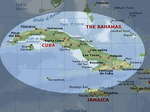
Open doors to Cuba
Published: Monday, November 5, 2007
Eugene, OR Register-Guard
--------------------------------------------------------------------------------
The Fidel Castro era will soon end in Cuba. Some believe it ended when Raul Castro, Fidel’s 76-year-old brother and designated successor, took over everyday management of the country for his ailing brother.
The United States is uniquely positioned — geographically, economically and historically — to promote democracy in post-Castro Cuba. Yet President Bush perversely clings to the same failed U.S. policies that after 45 years have failed to bring about democracy — or any other positive change — in Cuba.
In a recent speech, the president once again rolled out the treadworn mantra that the best way to bring freedom to Cuba is by continuing the U.S. economic embargo and by convincing Europe and Latin America to impose similar sanctions. While Bush held out the promise of eventual debt relief, loans and grants to the Cuban government, he made clear such measures are off the table until Cuba allows free speech and open elections.
Bush called on officials in Cuba’s government and security services to “rise up” against the Castro regime and to demand democratic reforms. It’s an exhortation that’s unlikely to win the hearts of Cubans who deeply resent the U.S. embargo and Bush’s wrongheaded efforts to make it more difficult for Cuban-Americans to assist or visit their families on the island.
The decades-long policy of isolation has inflicted great pain and suffering on the Cuban people, and it has strengthened Castro’s grip on power by fueling the nationalist sentiment on which he thrives.
Raul Castro understands how to play the nationalist card, as well. His foreign minister, Felipe Perez Rogue, denounced Bush’s speech as “equivalent to the reconquest of Cuba.”
Bush’s comments were intended to play to his conservative base, but he should reconsider. Unlike their parents, many younger Cuban-Americans do not share an unqualified loathing for the brothers Castro and do not identify with conservatives.
The president also should recognize that the rest of the world has abandoned economic sanctions as a useful tool to bring about democratization. When the United Nations recently voted to oppose U.S. sanctions against Cuba, only three nations — the Marshall Islands, Palau and Israel — stood with the United States in opposition.
The time has come for a fresh approach to Cuba, one that emphasizes diplomacy and contact with American society — and that recognizes that U.S. openness is a sign of strength, not weakness. Opening a free flow of commerce, tourism and culture would do far more to make Cuba an open society than clinging to failed isolationist policies.
Congress should find ways to forge ties with Cuba. Rep. Charles Rangel, D-N.Y., has introduced legislation that would permit free travel to Cuba, a move that would foster a free flow of ideas and spur democratization.
Congress also could offer to dial down the trade embargo in exchange for release of political prisoners and other incremental steps toward democratic reform.
The United States should replace its failed policy of isolation with one of engagement that encourages Cuba’s inexorable transition from dictatorship to democracy.
Tuesday, November 6, 2007


Sixteen Year Record of UN Vote Against the Embargo
Yes-No
1992 59-2 (US, Israel)
1993 88-4 (US, Israel, Albania, Paraguay)
1994 101-2 (US, Israel)
1995 117-3 (US, Israel, Uzbekistan)
1996 138-3 (US, Israel, Uzbekistan)
1997 143-3 (US, Israel, Uzbekistan)
1998 157-2 (US, Israel)
1999 155-2 (US, Israel)
2000 167-3 (US, Israel, Marshall Islands)
2001 167-3 (US, Israel, Marshall Islands)
2002 173-3 (US, Israel, Marshall Islands)
2003 179-3 (US, Israel, Marshall Islands)
2004 179-4 (US, Israel, Marshall Islands, Palau)
2005 182-4 (US, Israel, Marshall Islands, Palau)
2006 183-4 (US, Israel, Marshall Islands, Palau)
2007 184-4 (US, Israel, Marshall Islands, Palau)
Weakness of Dissidents
In Cuba, dissidents say opposition groups are weak
Sun Nov 4, 2007 3:02 am (PST) South Florida Sun-Sentinel.com
sun-sentinel.com/news/columnists/sfl-lrndcubanotebook1104nbnov04,0,3656630.column
Ray Sanchez
Cuba notebook
November 4, 2007
HAVANA
More than 200 people had mobilized for the late September protest demanding freedom for political prisoners. But state security agents intercepted many of the dissidents outside the capital and detained them for hours.
"People were picked up on roads; others were prevented from leaving their homes," said Martha Beatriz Roque, 62, one of the organizers. An economist by profession, Roque has pushed against the Castro government for 17 years and served two prison terms for her efforts.
In the end, only eleven people attended the peaceful demonstration outside Cuba's Justice Ministry. It quietly fizzled when police loaded the demonstrators on a bus and drove them home.
More than a year after Fidel Castro fell ill and ceded power to brother Raul, dissident groups on the island lack the strength and organization to force political change, analysts in the United States and dissidents on the island said. The opposition is not only infiltrated by state security but also hampered by conflicting views on how to bring about economic and political change and a widespread belief they're paid agents of the United States.
"In some cases, the dissidents have enormous dislike and distrust for one another," said Frank Mora, a Cuba expert at the National War College in Washington, D.C. "When I hear people outside Cuba talking about dissidents or pro-democracy activists or agents of change, I don't see that as being the reality on the ground in Cuba."
With about 300 dissident and human rights groups nationwide, the opposition has competing views on whether members of the current communist government should have a say in a post-Castro Cuba. In addition, some dissidents oppose the U.S.-imposed economic embargo and travel restrictions against Cuba, while others favor the current hard line.
"The entire weight of the opposition together, including the pro-democracy and human rights movements, is not enough to confront the regime politically," said veteran rights activist Elizardo Sanchez of the Cuban Commission on Human Rights and National Reconciliation.
Washington doesn't share that view. On Oct. 24, in his first major policy speech on Cuba in four years, President George Bush suggested that the opposition was prepared to rise up against the Castro government.
"The dissidents of today will be the nation's leaders tomorrow,” and when freedom finally comes, they will surely remember who stood with them," Bush said.
Many of the island's leading dissidents gathered at the U.S. Interests Section to hear Bush's speech live, but dissident Manuel Cuesta deliberately stayed away. A member of a social-democratic group that favors dialogue with the current government, Cuesta instead waited until the next day to read a full transcript of the speech that a friend had quietly pulled from the Internet. "In Cuba, there are things that shouldn't be done in order to advance your cause," he said. "I try to avoid the Interests Section when it comes to political matters."
Cuban authorities characterize dissidents and other government critics as mercenaries and counterrevolutionaries paid by Washington to undermine Castro's socialist system. Contact with the U.S. Interests Section only underscores that suspicion.
Cuesta, a 44-year-old historian, called the Bush speech "a lot of wishful thinking."
"Bush never used the words peaceful or dialogue or reconciliation," he said.
Cuesta and other dissidents said the opposition has not fully recovered from a three-day government crackdown in March 2003, when 75 dissidents were rounded up and jailed. Sixteen of the original 75 have since been released for medical reasons.
No clear opposition leader has emerged with the influence to marshal widespread support. Cuba also lacks strong civil groups like those in communist-era Poland. There, the Solidarity movement joined a powerful Roman Catholic Church and labor unions to topple the government.
Disarray among Cuba's opposition was underscored after the July 31, 2006, announcement that Fidel Castro was transferring power to younger brother Raul. Cuesta said dissidents learned a hard lesson: they were woefully unprepared to reach a Cuban public that knew little about them.
"We were caught with our pants down," he said. "Many opposition leaders call for free and democratic elections right now. But if Raul Castro decided to hold an election in, say, six months, the opposition wouldn't capture a municipal seat."
Ray Sanchez can be reached at rlsanchez@sun-sentinel.com
Cuban Foreign Minister on Bush Speech, UN Vote
AP Interview: Cuban foreign minister says country is prepared if Bush chooses to attack
The Associated Press
Tuesday, October 30, 2007
UNITED NATIONS: Cuba's foreign minister warned U.S. President George W. Bush on Tuesday that if the United States wants to bring about regime change by force in Cuba, his country is prepared.
The conflict will not only jeopardize Cuba's stability but U.S. stability as well, Felipe Perez Roque said in an interview with The Associated Press.
"We are not threatening and we never bluff," he said. "We respect the United States, but we demand respect for ourselves, and we would defend our country from an attempt to have foreign aggression."
He said Bush's first major policy speech on Cuba in four years, in which the president challenged the international community to help the people of the communist island shed Fidel Castro's rule and become a free society, indicated the president might be prepared to use force.
"Bush said in last week's speech that "the operative word in our future dealings with Cuba is not stability. The operative word is freedom." Perez Roque singled out the "irresponsible phrase."
"If that is the expression of the decisions that the president may be planning to make, it would be very dangerous both for Cuba and for the U.S., because if that's the expression of the attempt to bring about a regime change by force in Cuba, that will clash with the resilience of the Cuban people, and the people are prepared," Perez Roque said.
In Cuba, he said, more than 90 percent of the 11.5 million people support "the genuine revolution" that began in 1959 when Castro toppling dictator Fulgencio Batista.
The only "freedom" that Cubans can imagine Bush pursing, Perez Roque added, "would be similar to the one he has taken to Iraq" where the war has claimed hundreds of thousands of lives.
"An attempt to bring about a change in regime in Cuba is going to jeopardize not only Cuba's stability, but also the stability of the United States because then a conflict would be unleashed very close to their shores," Perez Roque warned.
The history of the Cuban revolution is to defend the country against outside forces, he said.
"We cannot be intimidated. we cannot be misled, and the fact must be accepted that we are a sovereign, independent nation," he said.
Perez Roque was interviewed shortly after the U.N. General Assembly voted overwhelmingly to urge the United States to end its 46-year-old trade embargo against Cuba. The vote in the 192-member world body — 184 to 4 with 1 abstention — was the highest in 16 years for the resolution.
Calling it "an historic victory," the Cuban minister said it was the international community's answer to Bush's speech and showed global support for "the Cuban right to be an independent nation, to be respected in its right to self-determination."
Even though the resolution is not legally binding, Perez Roque said the vote "has a very important ethical and moral meaning" and strengthened "our resilience and our decision, really, to resist and finally to defeat the blockade."
In his speech, Bush mentioned neither Fidel nor his brother, Raul, by name. Raul Castro has been the island's interim ruler since July 2006 while the 81-year-old Fidel recuperates from ill health.
But Bush said "the dissidents of today will be the nation's leaders" after the Castro era, and he told the Cuban military: "You may have once believed in the revolution. Now you can see its failure."
The U.S. has no diplomatic relations with Cuba, lists the country as a state sponsor of terror, and has long sought to isolate it through travel restrictions and a trade embargo, which has been tightened over Bush's two terms. This year, the U.S. stepped up enforcement of financial sanctions, which Perez Roque strongly denounced.
The Bush administration sees Castro's failing health as an opening for change. Little is different under Raul Castro, 76. Bush said in his speech that the U.S. will make no accommodations with "a new tyranny."
Perez Roque called Bush's statements "the expression of the failed policy of the United States towards Cuba," which was demonstrated by the total lack of support for the U.S. in Tuesday's vote.
Bush "should put aside his arrogance and humbly recognize" that the U.S. is isolated, and "he should also rectify his policy that causes hardships and suffering to the Cuban people."
"Cuba doesn't pose a threat to the U.S. Cuba is a country that would like to have normal relations with the United States. Our leaders have stated so publicly. However, we have just received more blockade and more aggressions from the current president of the U.S," he said.
Perez Roque said he would like the next U.S. administration to sit down with the Cuban government and negotiate improved relations.
"I would like it to be that way, but I'm not dying with anxiety to see it happen," he said.
"But if the next administration persists on following (the) wrong policy of blockade and aggression against Cuba, then you will also find us there prepared, and you will crash head-on into our resistance," he warned.
Perez Roque said Fidel Castro is continuing his recovery, and met with him last Friday to discuss his General Assembly speech — "and he made some useful suggestions in my statement to make it better." But he said he could not speculate on whether Fidel would return to power soon.
As for Raul Castro, Perez Roque said despite being demonized by some of the media, the acting president "has a great deal of moral authority in Cuba" because of his role in the revolution, and "a lot of sympathy and a great deal of support among the Cubans."
"The Cubans feel that they are close of Raul, as they've been with Fidel, and in Cuba it was no surprise that with Fidel's disease, Raul was called upon to take over," Perez Roque said.
Asbury Park Editorial on Bush Speech, UN Vote
U.N. vote adds to Cuba embargo tale
Posted by the Asbury Park Press on 11/5/07
http://www.app.com/apps/pbcs.dll/article?AID=/20071105/OPINION/711050324/1030/OPINION
Seven days after President Bush called on the world's nations to "make tangible efforts" to support his campaign to undermine the government of Cuban leader Fidel Castro, he got a resounding answer.
On Oct. 23, 184 of the United Nations' 192 member countries voted to condemn the U.S. embargo of Cuba — an economic stranglehold that's been in place for nearly half a century.
Only delegates from the United States, Israel, Palau and the Marshall Islands voted against the nonbinding resolution. Micronesia abstained. Albania, El Salvador and Iraq didn't bother to vote.
Imagine that. The Bush administration couldn't even get Iraq to back the embargo.
The U.N. vote marked the 16th consecutive year the world body has proclaimed its opposition to the embargo. But this year's vote was the most telling. It came in the wake of a major policy address Bush gave on Cuba in which he said the ongoing transition of power from Fidel Castro to his younger brother Raul is unacceptable.
"Life will not improve for Cubans under their current system," Bush said. "It will not improve by exchanging one dictator for another. America will have no part in giving oxygen to a criminal regime victimizing its own people. We will not support the old way with new faces, the old system held together by new chains."
Cuba, Bush said, "is a tropical gulag."
So why did the vast majority of nations — including all but one of this country's closest allies — support a call for ending the embargo? Because it's a bad idea that has only gotten worse with age. What started out as a prohibition against Americans traveling to Cuba and a ban on U.S. companies doing business there has morphed into something even more troubling.
In 1996, Congress passed the Helms-Burton Act, which imposes a steep fine on Americans who travel to Cuba without permission and allows the U.S. to levy sanctions against foreign firms doing business there. That's right, we've made it illegal for companies in other countries to do business in Cuba. While this law has proven difficult to enforce, it has outraged most of the world's governments.
Consider this as well: More than a few nations believe the only "tropical gulag" in Cuba is the U.S. naval base at Guantanamo Bay. It's there, near Cuba's southeastern tip, that the Bush administration has held hundreds of foreign terrorism suspects for years without charges.
Back in June, former Secretary of State Colin Powell — whom the Bush administration used to make the case for war in Iraq before the United Nations — said the Guantanamo Bay prison should be closed.
"Essentially, we have shaken the belief that the world had in America's justice system by keeping a place like Guantanamo open," Powell said.
That it hasn't been closed makes Bush look like a hypocrite for condemning the Castro government for jailing Cuban dissidents.
Powell's condemnation of the terrorist prison comes four years after the Senate and House voted to ease the embargo against Cuba. At the time, both bodies were controlled by Republicans.
The legislation was pushed by farm-state Republicans. The embargo prevents American farmers from selling most of their products to Cuba's 11 million people. The legislation was derailed by Republican congressional leaders.
The point here is that Bush has little support for his Cuba policy among Democrats or members of his own party — or the world in general.
Instead of trying to get others to embrace his failed Cuba policy, Bush should forge a new one. He should end the ban on Americans traveling to Cuba and allow American firms to do business there.
UN Votes 184 - 4 Against Embargo
Overwhelming UN support to end US embargo on Cuba
10/31/07
UNITED NATIONS (AFP) — The UN General Assembly on Tuesday [October 30] voted overwhelmingly for the 16th year in a row to demand an end to the crippling US trade embargo against Cuba, despite Washington's pledge to keep it in place.
By a vote of 184 in favor, it reiterated its "call upon all states to refrain from promulgating and applying laws and measures (such as those in the US embargo) in conformity with their obligations under the Charter of the United Nations and international law."
The 192-member assembly again urged "states that have and continue to apply such laws and measures to take the necessary steps to repeal or invalidate them as soon as possible in accordance with their legal regime."
Like last year, four countries -- the United States, Israel, Marshall Islands and Palau -- voted against the resolution and one, Micronesia, abstained.
Cuban Foreign Minister Felipe Perez Roque immediately hailed the vote as a "splendid victory" coming less than a week after US President George W. Bush vowed to keep in place the US sanctions, which were imposed 45 years ago against the communist-ruled island following the failed Bay of Pigs invasion by US-backed Cuban exiles.
"As long as the regime maintains its monopoly over the political and economic life of the Cuban people, the United States will keep the embargo in place," Bush said.
"I think the president's remarks stand," US national security council spokesman Gordon Johndroe said Tuesday in reaction to the UN vote.
The margin of support for ending the embargo has grown steadily since 1992 when 59 countries voted in favor of the resolution. The figure was 179 in 2004 and 182 in 2005.
Addressing the Assembly ahead of the vote, Perez Roque said the economic and trade sanctions were having a crippling effect, and estimated Cuba had suffered losses of "no less than 222 billion dollars," based on the US dollar's current value.
The blockade "has never been applied with as much ferocity as in the past year," he said, noting that Washington even barred US companies from providing Internet services to Cuba and was denying Cuban children access to needed medication.
And he later told AFP that the vote was "the expression of the virtual universal rejection of the policy of blockade and aggression which Bush, like no other US president, has applied toward Cuba."
He said ailing Cuban President Fidel Castro "followed the (UN) debate live and was the main architect of this victory because he embodies like no-one else the will of Cubans to be a free people despite the embargo and the aggressions we have suffered."
The 81-year-old Castro has been sidelined from power since he underwent gastrointestinal surgery in July 2006. His brother Raul Castro, 76, is serving as interim president.
Ronald Godard, the US State Department's senior advisor for Latin American affairs, blamed the communist regime for the country's woes.
"Cuba's problems derive not from any decision of the United States, but from the embargo on freedom that the Cuban regime has imposed on its own people," he said.
"We call on the international community to join together in demanding that the Cuban government unconditionally release all political prisoners as the essential step in beginning a process that restores to the Cuban people their basic human rights," he told the assembly.
Several speakers denounced the embargo slapped on Cuba on February 7, 1962 by the US administration under the late president John Kennedy.
Egypt's UN envoy, Maged Abdelaziz, said the Non-Aligned movement "reiterates its deep concern over the widening of the extra-territorial nature of the embargo against Cuba and rejects the reinforcement of the measures adopted by the US government aimed at tightening the embargo."
Pakistan's deputy UN ambassador Farukh Amil, speaking on behalf of another grouping of 130 nations, called for greater dialogue and cooperation to "contribute greatly not only toward the removal of tensions, but also promote meaningful exchange and partnership between countries whose destinies are linked by history and geography."
Speaking on behalf of the European Union, Portuguese delegate Jorge de Lemos Godinho said: "we express our rejection of all unilateral measures against Cuba which are contrary to commonly accepted rules of international trade, and repeat our view that the lifting of the US trade embargo would open Cuba's economy to the benefit of the Cuban people."
Lou Perez Op Ed on Bush Speech
News Observor, Raleigh, NC
Point of View: Published: Oct 31, 2007
Reshaping Cuba from Washington
Louis A. Perez Jr.
CHAPEL HILL - President Bush's reaffirmation of his position on Cuba last week serves to remind us of the continuing short-sightedness of U.S. policy. It defies logic.
With Vietnam and Libya, the United States establishes diplomatic relations and expands trade and aid agreements as a policy of constructive engagement to promote democracy; with Cuba the United States maintains political pressure and increases economic sanctions as a policy of punitive isolation in the name of promoting democracy.
And it is precisely that isolation -- of the United States -- that bodes ill, for the government denies itself access to Cuba at a time of change on the island.
The long-awaited transition in Cuba has begun. But political change in Havana has elicited no policy change from Washington. The president's speech last week indicates that he intends to "stay the course" in regard to Cuba. The embargo has assumed a life of its own: Its very longevity serves as the principal rationale for its continuance.
To paraphrase the Otis Redding lyric, the United States has been embargoing Cuba for too long to stop now.
But the president's comments bode ill for other reasons. The administration that will not speak to the Cuban government now presumes to speak to and on behalf of the best interests of "the Cuban people." In the weeks following Fidel Castro's illness in 2006, Secretary of State Condoleezza Rice assured Cubans directly that "all of you must know that you have no greater friend than the United States of America." Bush last week also reassured Cubans that "the American people care about you."
These warm well-wishes are received with blank incredulity in Cuba, for they come from an administration that has single-mindedly adopted measures designed to worsen the conditions of daily life for the very people for whom it professes to "care about."
The United States insists that the embargo is not directed against the Cuban people, but rather against their government. In fact, the people have borne the full brunt of punitive sanctions.
The embargo, after all, was conceived with the intent to politicize hunger as a means to foment popular disaffection, in the hope that Cubans, driven by want and motivated by despair, would rise up against their government.
"The only foreseeable means of alienating internal support is through disenchantment and disaffection based on economic dissatisfaction and hardship," a State Department memo insisted as early as 1960, and advocated measures "to bring about hunger, desperation and overthrow of government."
The United States appears to have adopted the stance that it is OK to punish the Cuban people for their own good. Not a good way to win friends and influence people in Cuba.
Bush's speech, further, implies a far more insidious intent. The president appears to be inciting Cubans to rebellion.
"You have the power to shape your own destiny," he exhorted. How this would be achieved was not made clear, except that the president also addressed the Cuban armed forces, and suggested portentously: "When Cubans rise up to demand their liberty ... you've got to make a choice." And the choice? To "defend a disgraced and dying order by using force against your own people" or "embrace your people's desire for change."
The phrase "using force against your own people" provides insight into the meaning of the president's intent. Is this what the Cuba policy of the United States has come down to: inciting Cubans to rebellion and warning the armed forces against suppressing rebellion?
The administration's policy belies its claim to desire agency for the Cuban people. It plans unilaterally for the future of a "post-Castro" Cuba, apparently untroubled by the total exclusion of the people who live there. When it comes to the matter of the future of Cuba, the participation of the Cubans who live in Cuba is deemed unnecessary: hardly reassuring to Cubans who are exhorted to shape their own destiny.
Without the political will to engage a Cuban government in transition, it is not certain that the Bush administration possesses the moral credibility to engage the Cuban people. It would perhaps best serve the interests of both countries for the United States to show respect for the Cuban people by acting on the premise that Cubans in Cuba know what is in their best interest.
(Louis A. Perez Jr. is the J. Carlyle Sitterson professor of history and director of the Institute for the Study of the Americas at UNC-Chapel Hill. He is the author of the forthcoming book "Cuba in the American Imagination.")
Subscribe to:
Posts (Atom)