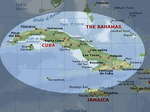
AMANPOUR: Welcome back.
Fifty years after Fidel Castro declared Cuba a communist state, the US embargo remains. But the Castro brothers retain their iron grip.
It's been a fraught history between the two nations, from the Bay of Pigs invasion to the Cuban missile crisis. But for the first time now, a US president has been elected without making concessions to the powerful Cuban-American lobby.
In a moment, we'll talk to a US congressman who's trying to change American policy on Cuba - Howard Berman, chairman of the House Foreign Affairs Committee.
(BEGIN VIDEOTAPE)
We asked the Cuban government representatives to join us, but they all told us they were not available at this time. We hope that they will in the future.
But right now we're joined here in our studio by Jose Miguel Vivanco, the director of Human Rights Watch Americas Division, which just published a highly critical report on Cuba. And from Washington, US Congressman Howard Berman, who joined us from Capitol Hill and who's been holding those hearings.
Welcome both gentlemen to our program.
Congressman Berman, if I could ask you, what precisely is the point of your hearings? What can you achieve?
REP. HOWARD BERMAN (D), CALIFORNIA: I'd like the Congress to re-examine the ban on travel. Americans can go to a country, Iran, that is developing a nuclear weapon that is the leading state sponsor of terrorism. During the Cold War, we never restricted the ability of Americans to go to the Soviet Union or other Soviet block countries.
I think our current policy interferes with what I consider a fundamental American right, the right of American citizens to travel.
AMANPOUR: And just to be clear, Congressman, if you lift the ban on Americans traveling, in a sense, de facto, the embargo collapses, correct?
BERMAN: No. I think the embargo and the travel ban are two very separate issues. There are all kinds of items - we have an embargo on Iran right now. We don't have a travel ban on Americans going to Iran.
AMANPOUR: OK.
BERMAN: And they're - they're are two separable (ph) issues.
AMANPOUR: All right. Let me turn to Jose Miguel Vivanco who's just come back from Cuba. You've written a highly critical report for Human Rights Watch called "New Castro, Same Cuba." What did you find there?
JOSE MIGUEL VIVANCO, DIRECTOR, HUMAN RIGHTS WATCH, AMERICAS: Well, the conclusion is that under Raul Castro, essentially is the same type of repression that has been ongoing in Cuba for 50 years under Fidel Castro is - is very much in place.
AMANPOUR: More specifically?
VIVANCO: Specifically going after anybody who disagrees with the system. You know, in other words, you have a system - a totalitarian system that negates the exercise of fundamental freedoms and rights. No - no free speech, no right to association, no right to, you know, to create a union, labor rights, no political rights to elect, you know, anybody who is not endorsed or official candidate of a.
AMANPOUR: So do you - do you believe that the travel ban should be lifted, for instance, as Congressman Berman says?
VIVANCO: Absolutely. And we submitted, actually, a - a letter to the committee of Chairman Berman, requesting and supporting to - to release the travel ban.
Essentially, our position is human rights conditions are still extremely poor. You know, Raul Castro's record is characterized by massive and gross violations of human rights. The best way to address this problem is by not only lifting the travel ban, but also replacing the embargo with effective pressure that could be exercised essentially multilaterally.
AMANPOUR: Let me play this sound bite from Yoani Sanchez, the notorious now blogger there.
(BEGIN VIDEO CLIP)
YOANI SANCHEZ, CUBAN BLOGGER (through translator): They threw me in the backseat of the car, upside down. Then a very strong man placed his knee on my chest and I couldn't breathe.
The man in the front seat was hitting me in my back and pulling my hair. He said, "Yoani, this is it," and, at that moment, I thought I was going to die.
(END VIDEO CLIP)
AMANPOUR: Congressman Berman, does that kind of - of testimony from inside Cuba, what you've just heard about the Human Rights Watch's rather scathing report, does that make it more difficult for you as you're holding these hearings?
BERMAN: I think it makes our case more compelling.
AMANPOUR: How's that?
BERMAN: Because the Cuban dissidence, the people - the brave people in Cuba who are standing up to this despotic regime, they want more contact with Americans. They want Americans coming to Cuba. They believe this will help bring down the wall that separates the government from its own people.
Our whole history with Eastern Europe and - and Russia, Americans traveling there meant American contact with dissidents, promoting American values, bringing to the people of these countries, as they would to the Cuban people, the story of what - of what freedom and liberty are really like.
AMANPOUR: Congressman Berman, as chairman of the House Foreign Affairs Committee, what do you see happening in your committee in Congress regarding the Cuban issue? Is sentiment shifting away from this - this embargo?
Certainly, Cuban Americans, by a vast majority, want the embargo lifted and certainly the travel ban lifted.
BERMAN: Well, you make a very good point. The - there is a change of position going on within the Cuban-American community. More and more of them realize the futility of the travel ban in terms of achieving our shared goals, and in addition we now have something like 175, getting close to - getting close to half of the members of Congress co-sponsoring the legislation to repeal the travel ban.
There is no doubt that we are in a much better situation now than we were, even a few years ago, not because of anyone being enamored with Castro. We - we stand, I think, united in a bipartisan way against his repressive policies. But because we believe that the Cuban people and the American people will be better off.
AMANPOUR: The Cuban government often says that these repressive measures are in place to defend against a hostile United States. Do they have a point?
VIVANCO: Well, they have (ph) - using that, manipulating the US foreign policy of isolation. That's why - that is one of the reasons why we believe it's necessary to change the policy.
The policy of isolation that is essentially a policy of regime change, because that is what Washington has been trying for almost 50 years. Regime change is rejected by the - the rest of the world. Nobody in Europe agree with the US. Nobody in Latin America. No - no - there is not a single, you know, solid democracy in the world that is supporting regime change and isolation against the - the Cuban government.
So that's why it's important to build up a multilateral coalition that has the political power and the moral authority to exercise an effective pressure on the Cuban government.
AMANPOUR: Congressman Berman, again, to you also, the Cubans often justify whatever policy they have as standing against hostility from the United States. Do they have a point? And how can you promote change? It's obviously not going to come from outside, like regime change. How can you promote change there, if that's what you're seeking?
BERMAN: Well, I'm not - I'm not here to say that getting rid of the travel ban will meet the immediate change in - in the regime. But my - in my heart of hearts, I believe that Castro does not want the travel ban to be repealed. He loves using American policy as a scapegoat for his own repression and for the terrible economic conditions the Cubans now live under. We are serving his purposes by our current policy.
AMANPOUR: And do you believe that this will get through Congress and get through the Senate? What do you believe?
BERMAN: I think it has a better chance than it's had since the policy was formulated.
AMANPOUR: All right. Thank you very much, indeed, Congressman Howard Berman, chairman of the House Foreign Affairs Committee. Thank you very much, indeed. And Jose Maria (ph) Vivanco, thank you very much indeed for joining us.
And when we come back, we will speak to two who've just been there, including a European commissioner who met with the country's leader and also a former US State Department official who's also just returned from Cuba. That's when we return.
(END VIDEOTAPE)
(COMMERCIAL BREAK)
(BEGIN VIDEO CLIP)
UNIDENTIFIED MALE (through translator): The worst impact of the embargo is on food and problems with medicine. There are things we simply can't get because of the embargo.
UNIDENTIFIED FEMALE (through translator): I wish they would fix everything because I have family in the United States - my brother, cousins. Speaking for myself, I personally have more hope in Obama than in any other American president that there has been.
UNIDENTIFIED MALE (through translator): Cuban people don't have anything against the American people, if you know what I mean, and we need to have relationships with them, just like with the rest of the world.
(END VIDEO CLIP)
AMANPOUR: That was the view from the streets of Havana just a few hours ago. And joining me now, two people who've just returned from Cuba, Karel de Gucht, European Commissioner for Development and Humanitarian Aide, and Lawrence Wilkerson, co-chairman of the US-Cuba Policy Initiative, now at the New American Foundation and former chief of staff to Secretary of State Colin Powell.
Both of you gentlemen, thank you so much for joining us.
Let me go to you, Mr. de Gucht. Can you just tell me - look, it's clear that the embargo has not worked, but also your policy of constructive engagement has not worked. What are you proposing now as a way to change what's happening in Cuba?
KAREL DE GUCHT, EU COMMISSIONER FOR DEVELOPMENT: First of all, the European Union does not support an embargo on Cuba. But you're right that also our policy of engagement up to now can show very little results.
We have come to the conclusion that most obviously pressure on this regime is not going to automatically change it. And that's why we have a policy to engage and also to engage in a way that we support directly the Cuban people.
For example the - after the hurricanes, we - we come in with help. We are helping to restructure the - the agricultural sector in - in Cuba, which is - this is primarily poorly managed (INAUDIBLE) with big state enterprises. We want to have subsistence agriculture.
So we try to engage with them and - and hope that over time the regime will change.
Now, the question is.
AMANPOUR: So, you're hoping.
DE GUCHT: . is there a way to make a change.
AMANPOUR: Basically you're hoping that it's going to collapse from within?
DE GUCHT: No, I've - I've never said that I - I hope that it collapses from within. I'm not talking about regime change. I think that should not be the purpose of our political actions.
AMANPOUR: OK.
DE GUCHT: But then, of course, we - we need the political courage to look at all the element of the discussion, and one of the elements that has not yet been mentioned in - in this program is the case of the Cuban Five.
It's obvious that if you want to negotiate on the liberating - the liberation of - of the all the political prisoners, then you have to talk also about all of the problems, included, I think, the Cuban Five.
AMANPOUR: OK. Let me ask.
DE GUCHT: . including the embargo and then I think we could come to a political result.
AMANPOUR: Let me ask Lawrence Wilkerson.
You've just come back from Cuba as well. Did you meet with any of the leaders there? What is your proposal for promoting change there? You also were talking about engagement, right, Mr. Wilkerson?
LAWRENCE WILKERSON, US-CUBA POLICY INITIATIVE: That's correct. And let me say first that I agree with Chairman Berman that this issue before us right now is full travel. And that's not an issue about Cuba, that's an issue about the rights of American citizens, and it's unconstitutional that we restrict them from traveling to Cuba.
Furthermore, we have a tyranny of the minority in this country right now. That is to say Cuban-Americans can visit Cuba, a very small minority, while the majority of Americans can't. That's unconstitutional. We need to change that.
AMANPOUR: Right. But the point is not about America's constitutional rights. It's about - it's about Cuba, right? I mean, it's about everybody except the United States thinking that the embargo has been ineffective.
Do you believe the embargo should be lifted?
WILKERSON: The embargo has been a colossal failure. The embargo has done nothing but isolate the United States of America.
AMANPOUR: Should it will lifted?
WILKERSON: There is a lot of Latin American leader. It should be. There is not a Latin American leader from Luis Inacio da Silva in Brazil to Stephen Harper in Canada who hasn't made it one of his talking points with the American president for some time now to lift the stupid, idiotic embargo.
It makes no sense. We need to move towards normalized relations.
AMANPOUR: So how do you promote change, or do you not promote change? Do you just have relations with this - with this government and wait out the Castro brothers until the end of their natural lives?
WILKERSON: Well, it's - it's quite clear that Raul and Fidel are not going to live that much longer. Isolated the way we are now on our side of the Florida Strait, we will have zero influence over what replaces the Castros.
I do not think that 50 years of failure is testimony to the reason we should continue it. We need to adopt a new policy. That policy needs to be a policy of engagement, so that we can have more impact on raising the standards of living of the average 11.5 million Cubans and so that we can be around when the change does, inevitably, occur.
AMANPOUR: OK. Let me just put this sound bite up from Representative Connie Mack, who obviously opposes Chairman Berman's travel ban hearings here.
(BEGIN VIDEO CLIP)
REP. CONNIE MACK (R), FLORIDA: This is a Castro bailout, Mr. Chairman, a bailout for beating, a bailout for oppression, a bailout for rape, a bailout for torture, a bailout for corruption, a bailout for tyranny.
Mr. Chairman, going sightseeing to view political prisoners will not bring democracy to Cuba.
(END VIDEO CLIP)
AMANPOUR: OK. I want to go to you, Mr. de Gucht, because it looks like Europe and certainly this - the Spanish EU presidency that when they take over the leadership, you want to remove Cuban rights from the so-called "Common Position." Why would you do that? What effect would that have?
DE GUCHT: Well, simply because we think that the Cubans have a point. We have relations with a lot of oppressive regimes and - and we have a special regime for Cuba. It makes no sense singularizing them. I think we should stop the singularizing but also be much fervor (ph) on what we expect them to do in the future.
Another remark I would like to make, if - if you permit me to do so, is - is that the idea that if the Castros physically were to disappear, which is going to happen sooner or later with everybody of us, by the way, that all of a sudden the regime would change. I don't think that's true. I'm just (INAUDIBLE).
AMANPOUR: Mr. Wilkerson, last question to you. What do you think President Obama could do more than he's doing already? We've already established that he's not in hoc (ph), so to speak, to the Cuban-American lobby and the majority of Cuban-Americans want the embargo lifted.
What should the president of the United States be doing now?
WILKERSON: This may surprise you. I like what he's doing. He's moving very slowly, very incrementally. He's got a lot of other things that are far more important on his plate from Afghanistan to health care, and I like what he's doing. At low levels right now, we're having talks on immigration, on postal service and other matters like that, and I think he's moving as fast as he can.
AMANPOUR: Thank you very much indeed. It looks like it is moving, certainly compared to what was going on over the last several years.
Both of you gentleman, thank you very much for joining us and we'll continue to look at this issue.
And we have something special for you from Cuba when we come back - a side of Havana and the rest of the island that you may not normally see.
(COMMERCIAL BREAK)
AMANPOUR: Cuba is one of the most musical countries in the world, and that is the Buena Vista Social Club which helps send Cuban music global.
But listen to the new sound that our Morgan Neill found coming out of Havana these days, and meet the man who's making it.
(BEGIN VIDEOTAPE)
MORGAN NEILL, CNN HAVANA BUREAU CHIEF (voice-over): Aldo Rodriguez of Los Aldeanos - in English, The Villagers - is part of Cuba's underground hip hop movement. He lays down basic tracks in his bedroom on an old computer. He says distribution is hand to hand on homemade CDs, copied over and over.
His lyrics are direct, and they don't pull punches. For example, in the song "Ya Nos Cansamos" (ph), which translates roughly as "We're Fed Up," you'll find this verse...
ALDO RODRIGUEZ, CUBAN HIP-HOP ARTIST (through translator): They're always saying everyone is equal, but you tell me if the doorways are falling down in the generals' houses. Of course in Cuba all the hospitals are free. But who do they treat better, the officials or me?
NEILL: "It's not anything bad," he says, "It's just the truth, and the people aren't used to hearing it.
(END VIDEOTAPE)
AMANPOUR: Aldo Rodriguez says that he's got nothing against his government, but he also says that he will not be silent. "I'm young and I've got a right to express myself," he says.
Monday, December 7, 2009


Thursday, November 19, 2009
Human Rights Watch Supports End of Trade and Travel Bans
HRW: We favor an end to the travel ban
On the eve of a House committee hearing on the U.S. travel ban to Cuba, a Human Rights Watch official went on record as saying that his organization believes "lifting the travel ban represents an essential step towards ending a U.S. policy that has failed for decades to have any impact whatsoever on improving human rights in Cuba."
In a letter to the chairman of the House Committee on Foreign Affairs, Rep. Howard Berman (D-Ca.), José Miguel Vivanco, director of the HRW's Americas Division, pointed out that HRW had just issued a report critical of the Cuban government and then made the following points:
"Efforts by the U.S. government to press for change by imposing a sweeping ban on trade and travel have proven to be a costly and misguided failure. The embargo imposes indiscriminate hardship on the Cuban population as a whole and has done nothing to improve the situation of human rights in Cuba.
"Rather than isolating Cuba, the policy has isolated the United States, enabling the Castro government to garner sympathy abroad while simultaneously alienating Washington's potential allies.
"There is no question: the Cuban government bears full and exclusive responsibility for the abuses it commits. However, so long as the embargo remains in place, the Castro government will continue to manipulate U.S. policy to cast itself as a Latin American David standing up to a U.S. Goliath, a role it exploits skillfully.
"Ending the travel ban is a step in the right direction toward reforming this failed policy, and Congress should act swiftly to pass the Freedom to Travel to Cuba Act.
"...Human Rights Watch recommends that the U.S. government replace its failed embargo policy with a more effective, multilateral approach. Our report lays out a proposal for the United States to work with allies in the European Union, Canada, and Latin America to forge a new coalition that will exert targeted pressure on the Raúl Castro government to release all political prisoners."
Tuesday, November 17, 2009
Rep. Berman and Sen. Lugar Call for End of Travel Embargo
Lift the ban -- let Americans visit Cuba
Miami Herald
Posted on Tue, Nov. 17, 2009
BY RICHARD G. LUGAR and HOWARD L. BERMAN
www.lugar.senate.gov
U.S. law lets American citizens travel to any country on earth, friend or foe -- with one exception: Cuba. It's time for us to scrap this anachronistic ban, imposed during one of the chilliest periods of the Cold War.
Legislation to abolish restrictions on travel to Cuba has been introduced in both chambers of Congress. And on Thursday the House Foreign Affairs Committee will hold a hearing examining the rationale for the travel ban.
This ban has prevented contact between Cubans and ordinary Americans, who serve as ambassadors for the democratic values we hold dear. Such contact would help break Havana's chokehold on information about the outside world. And it would contribute to improving the image of the United States, particularly in Latin America, where the U.S. embargo on Cuba remains a centerpiece of anti-Washington grievances.
While opponents argue that repealing the travel ban would indicate approval of the Cuban human rights record, many human rights organizations -- among them Freedom House and Human Rights Watch -- have called for abolishing travel restrictions.
There is no doubt that Raúl Castro's government continues to ban most political activity not controlled by the Cuban Communist Party. Opposition parties are illegal, virtually all media remain state controlled, and Cuba has the highest number of political prisoners of any country in the Americas. But isolation from outside visitors only strengthens the Castro regime.
U.S. travelers' dollars, furthermore, could aid the underground economy and the small self-employed sector permitted by the state, strengthening an important foundation of independence from Cuba's authoritarian system.
Travel ban defenders view sanctions as leverage over the Cuban government and their abolition as a concession. But over the last five decades, it has become clear that isolation will not induce the Castro regime to take steps toward political liberalization. Conditionality is not leverage in this case.
Our current approach has made any policy changes contingent on Havana, not U.S. interests, and it has left Washington an isolated bystander, watching events on the island unfold at a distance.
Finally, while travel restrictions are contrary to our foreign policy interests, they also impede the right of Americans to freedom of speech, association and to travel. Sometimes a travel ban may be necessary, but nothing about the Cuba situation today justifies such an infringement on our basic liberties.
The Obama administration has already made a move in the right direction by lifting restrictions on travel and remittances for Cuban-Americans and opening the way for greater telecommunications links with the island.
It is now time for the Congress to take the next step for all Americans.
Sen. Richard G. Lugar, R-Ind., is the ranking member of the Senate Foreign Relations Committee. Rep. Howard L. Berman, D-Calif., is chairman of the House Foreign Affairs Committee.
http://www.miamiherald.com/opinion/other-views/story/1337127.html
Monday, November 16, 2009
PAC Shifts Votes
Posted on Mon, Nov. 16, 2009
Money talks: Report links donations, Cuba embargo support
Lesley Clark | McClatchy Newspapers
last updated: November 16, 2009 11:20:13 AM
WASHINGTON — Supporters of the U.S. embargo against Cuba have contributed nearly $11 million to members of Congress since 2004 in a largely successful effort to block efforts to weaken sanctions against the island, a new report shows.
In several cases, the report by Public Campaign says, members of Congress who had supported easing sanctions against Cuba changed their position — and got donations from the U.S.-Cuba Democracy Political Action Committee and its donors.
All told, the political action committee and its contributors have given $10.77 million nationwide to nearly 400 candidates and members of Congress, the report says.
The contributions include more than $850,000 to 53 Democrats in the House of Representatives who sent a letter to House Speaker Nancy Pelosi earlier this month opposing any change to U.S.-Cuba policy. The average signer, the report says, received $16,344.
The top five recipients of the embargo supporters' cash: Miami's three Cuban-American Republican members of Congress, 2008 Republican presidential nominee John McCain and New Jersey Democratic Sen. Robert Menendez, whose parents fled Cuba before his birth.
The report comes as defenders of the embargo fend off efforts to repeal a decades-old ban against U.S. travel to Cuba. Proponents of greater engagement with Cuba contend that they have the votes, and a hearing on the issue is scheduled for Thursday before the House Foreign Affairs Committee.
Critics of U.S.-Cuba policy long have suggested a link between campaign contributions and policy. Public Campaign — which advocates for public financing of political campaigns — says the contributions raise questions about the role that money plays in lawmakers' decision-making.
"The pressure they get to raise money plays heavier in their decisions than it ought to," said David Donnelly, the national campaigns director for Public Campaign. "We think this is a damning pattern. We think these are good people caught in a bad system. If members of Congress have to spend too much time raising money, they have to listen to people who give money."
The director of the U.S.-Cuba Democracy PAC, Mauricio Claver-Carone, defended the contributions as support for lawmakers who side with Cuban-Americans who think that easing sanctions against Cuba will only benefit the Castro regime.
"I will not apologize for the Cuban-American community practicing its constitutional, democratic right to support candidates who believe in freedom and democracy for the Cuban people over business and tourism interests," Claver-Carone said. "Unions help elect pro-union candidates. The Chamber of Commerce helps elect pro-business candidates. AIPAC (the American Israel Public Affairs Committee) helps elect pro-Israel members. Who are we supposed to help? Pro-Castro members?"
Public Campaign looked at the Cuba committee because of a seeming disconnect between congressional votes and public opinion polls that suggest most Americans support lifting a ban on travel to Cuba, Donnelly said.
"On this issue there appears to be a clear distinction between what the American public appears to want and what some in Congress are advocating," Donnelly said, pointing to a World Public Opinion survey in April that found 70 percent of Americans support travel to Cuba.
Rep. Jeff Flake, R-Ariz., who backs greater engagement with Cuba, said the report wasn't a surprise.
"I don't know how else you can explain how our current policy has survived for so long without yielding any meaningful results; it's all politics," Flake said.
The report says that at least 18 House members — including several from agriculture-rich districts — received campaign contributions from the PAC or its donors and switched their positions on Cuba, from voting in favor of easing travel restrictions to voting against any efforts to soften the embargo.
Rep. Mike McIntyre, D-N.C., said his changed views came from humanitarian interests and concerns about oppression in Cuba. He said he spoke with Florida Republican Reps. Lincoln and Mario Diaz-Balart about their family's experience in Cuba under Fidel Castro.
"I thought, 'This is not right, and it's not humanitarian, and it doesn't promote democracy and I'm not going to support someone who is repressive and evil,' " McIntyre said. "Yes, I changed my vote. That's the reason I changed: the horrors they suffered."
"They're really savvy people," Lars Schoultz, a professor of political science at the University of North Carolina-Chapel Hill and the author of "That Infernal Little Cuban Republic: The United States and the Cuban Revolution," said of the U.S.-Cuba Democracy PAC. "They know one vote is one vote. They scratch around and see who might be open to their way of thinking."
Claver-Carone, who started the PAC in 2003, said agricultural and business interests had heavily lobbied members of Congress before the committee was in operation.
"The farm lobby came in and they were telling people, 'Cuba is like Costa Rica,' " Claver-Carone said. "We came in and started telling people, 'Hey, here's what's really happening in Cuba.' "
Though hard-line embargo supporters traditionally have been considered Republicans, the report shows the PAC shifting contributions to Democrats as they assumed control of the House and Senate in 2006.
In the 2004 election cycle, the PAC gave just 29 percent to Democrats. By 2008, the Democrats' share was up to 59 percent.
(Barbara Barrett and David Goldstein contributed to this article.)
****************
My comment:
For an analysis of how pro-embargo PAC money has been directed to members of the House Committee on Foreign Affairs, go to
http://thehavananote.com/2009/11/the_money_game_1.html
For data on the PAC money received by Democratic signers of the anti-travel letter to Speaker Pelosi, go to
http://uscubanormalization.blogspot.com/2009/11/democratic-representatives-sign-anti.html
The PAC’s anti-Obama pro-Jeb Bush position can be seen at
http://uscubanormalization.blogspot.com/2009/11/clipping-file-us-cuba-democracy-pac-and.html
The general impression is that the money for the PAC is largely from conservative Republican Cuban Americans in the Miami area. However as far as I know, there has not been a serious analysis of the donor list and what their motives may be. Public information about all donors can be found at
http://www.opensecrets.org/pacs/pacgave2.php?cycle=2008&cmte=C00387720
Wednesday, November 11, 2009
Text of Letter from Anti-Travel Democrats
November 3, 2009
Speaker Nancy Pelosi
Office of the Speaker H-232, US Capitol
Washington, DC 20515
Dear Madam Speaker:
With Cuba being the subject of much media attention in recent days, we write to reaffirm the strong support within the House Democratic Caucus for maintaining current United States policy towards Cuba.
As you know, current US policy as codified under the Cuban Liberty and Democratic Solidarity (Libertad) Act of 1996, conditions the lifting of any trade, travel, and financing transactions with the Castro regime, on its unconditional release of political prisoners; recognitions and respect of the fundamental human, civil and political rights of the Cuban people; legalization of independent civil society groups, including journalists, political parties and labor unions; and democratic reforms leading to free and fair elections.
Under the Libertad Act of 1996, Congress also committed to empowering Cuba's courageous human rights and pro-democracy advocates in their struggle against oppression. With that commitment, Cuba's pro-democracy movement has grown exponentially and — in a country where the totalitarian regime controls all national media, writing "counter-revolutionary" articles for foreign websites can lead to a 20-year prison term, and Internet access is restricted to 1.3% of the population — has demonstrated tremendous resiliency.
For these reasons, reneging on our commitment would help to strengthen the Cuban regime's censors and do a grave injustice to those brave Cuban civil society leaders that challenge the regime's brutal repression on a daily basis. Any legislation that would seek to ease or lift sanctions, in disregard of these conditions in law, would send a devastating message to Cuba's opposition movement and legitimize an ailing dictatorship.
President Obama has honored his campaign promise to ease regulations on family travel and remittances, but has stated that he supports remaining sanctions. Specifically, the President said "My policy toward Cuba will be guided by one word: libertad'... the road to freedom for all Cubans must begin with justice for Cuba's political prisoners, the right of free speech, a free press, freedom of assembly, and it must lead to elections that are free and fair. That is my commitment."
President Obama has demonstrated his support for the remaining sanctions by word and deed. As evidenced by his signing an extension of the Trading with the Enemy Act towards Cuba, which authorizes restrictions on travel to Cuba.
Perhaps most importantly, the President has said he will maintain the U.S. trade embargo against Cuba until the Cuban government shows progress on human rights and democracy. We could not agree more.
A dictatorship and state sponsor of terrorism that has no regard for civil rights, religious freedom, open media, or any of the democratic ideals that we cherish, cannot be rewarded with legislation in Congress that would remove US sanctions and subsidize the Castro regime's human rights abuses.
We salute the President's vision for U.S. policy towards Cuba, and it is our strong belief that any effort to upend the President's agenda would undermine the goal that he shares with so many House Democrats — fostering respect for justice and freedom in Cuba.
Madam Speaker, thank you for your kind attention to this matter. We look forward to working with you to ensure that we honor the values that embolden our democracy, and that the Cuban government honors its obligations to its people.
Clipping File: US-Cuba Democracy PAC and the Republican Party
http://online.wsj.com/article/SB123879435046687885.html
Saturday, April 4, 2009
Some Cuban-American circles have pressed to maintain U.S. restrictions [on family travel] because of their antipathy for Fidel Castro and his brother, Raul, who replaced him as leader after Fidel became ill. "How do you help people speak out about human rights violations if you're basically extending the dictatorship abroad?" said Mauricio Claver-Carone, director of U.S. Cuba Democracy PAC.
*****************
http://www.justnews.com/politics/10581251/detail.html
POSTED: Thursday, December 21, 2006
Mel Martinez anoints fellow Republican Jeb Bush the first Cuban-American governor of Florida during a meeting of the U.S.-Cuba Democracy Pac at the Biltmore Hotel.
CORAL GABLES, Fla. -- It was a who's who of Cuban-Americans on Wednesday at the Biltmore Hotel, with special recognition for outgoing Gov. Jeb Bush.
U.S. Sen. Mel Martinez, R-Fla., applauded Bush "for having been our friend, for having been on the side of freedom and for always having been someone who understood and loved the Cuban-American community, so much so that I today gave him the title of the first Cuban-American governor," he said.
Bush, in his formal remarks, gladly accepted the title.
"If Bill Clinton can be the first African-American president, I can be the first Cuban-American governor of the state of Florida," Bush said to laughter and applause.
Politicians from near and far praised Bush, who is nearing the end of his eight-year term. Even U.S. Sen. Sam Brownback, R-Kan., showed up. He urged political leaders to act as a voice for Cubans and voiced his support for the Cuban embargo.
"Trading with Castro is not the way to bring about democratic change in Cuba," Brownback said.
The real reason for Bush, Brownback and everyone else's appearance was the cause of a free Cuba and concern for U.S. policy.
"The problem is not between the United States and Cuba," former Deputy Secretary of State Otto Reich said. "The dialogue that has to take place is between the Cuban government and the people of Cuba. Once that dialogue has taken place and the people of Cuba have had their liberties restored by that government, which is fully capable of restoring it, then the United States would be willing to begin a dialogue with the government of Cuba."
Not that long ago, the only group capable of drawing a crowd with the same type of political clout as the one at the Biltmore on Wednesday was the Cuban-American National Foundation. Now, the loudest voice for Cuban exile politics appears to be the U.S.-Cuba Democracy Pac.
"This group represents the entire community and is genuinely representative of the consensus of thought of the Cuban-American community, and that's why this group is so respected," U.S. Rep. Lincoln Diaz-Balart, R-Miami, said.
Copyright 2006 by Local10.com. The Associated Press contributed to this report. All rights reserved. This material may not be published, broadcast, rewritten or redistributed.
*****************
http://www.miller-mccune.com/politics/cuba-libre-345?article_page=2
"One of the fundamental strengths of our community has always been unity, and that unity has always been at the core of the economic and political success of Cuban Americans," says Mauricio Claver-Carone, the 32-year-old spokesman of the U.S.-Cuba Democracy PAC. "So when your campaign is based on a strategy of ‘divide and conquer,' I personally (don't believe), and our committee personally doesn't believe, that that is particularly helpful, because basically what you're doing is you're showing the world a disunified community."...
...The network was revealed prominently in early March, when two Democratic members of Congress from South Florida, Kendrick Meek and Debbie Wasserman Schultz, told The Miami Herald they will not support Garcia, Martinez and Taddeo in their races against the Diaz-Balarts and Ros-Lehtinen. They couldn't support their fellow Democrats, Meek and Wasserman Schultz said, because of their friendships with the Republican incumbents.
Democratic Party activists were incensed, especially with Wasserman Schultz. She is co-chair of the Democratic Congressional Campaign Committee's Red to Blue program, which has a stated purpose of finding districts with vulnerable Republicans and replacing them with Democrats. The Democratic activists pointed to another kinship she had with the Diaz-Balarts: the U.S.-Cuba Democracy PAC. In the past two election cycles, Wasserman Schultz received $22,000 from the committee, and members of the PAC's board of directors gave her another $29,000 in individual contributions, for a total of $51,000. Meek received $10,500 from the PAC.
Wasserman Schultz is hardly alone. Florida's Democratic U.S. senator, Bill Nelson, has taken campaign contributions of about $44,000 from the PAC and individuals on its board of directors.
****************
http://www.capitolhillcubans.com/2009_04_05_archive.html
From March 24 letter to Pres Obama published on Capitol Hill Cubans
However, in regard to Cuban American travel, we are troubled by the explanation in the “Guidance on Implementation of Cuba Travel and Trade-Related Provisions of the Omnibus Appropriations Act of 2009” that the general license grants “unlimited” lengths of stay in Cuba. We believe that this will serve to channel U.S. taxpayer dollars directly to the regime because retirees and Supplemental Security Income recipients could remain on the island indefinitely while collecting U.S. taxpayer-provided benefits.
Lincoln Diaz-Balart, Debbie Wasserman Schultz
Ileana Ros-Lehtinen, Kendrick Meek
Mario Diaz-Balart, Albio Sires
Robert Andrews, Frank Pallone
**********************
http://www.msnbc.msn.com/id/20369459/
Associated Press, Aug 21, 2007
MIAMI - Democratic presidential candidate Barack Obama is leaping into the long-running Cuba debate by calling for the United States to ease restrictions for Cuban-Americans who want to visit the island or send money home...
...Mauricio Claver-Carone, head of the U.S.-Cuba Democracy PAC, which supports full sanctions, said Obama’s statement could hurt U.S.-Cuban relations at a crucial time.
“I’m sure he’s well intentioned,” Claver-Carone said, but he added that with the death of Castro possibly approaching and the potential for change on the island, such a statement could send the wrong message.
“It entrenches the regime at this historic time,” Claver-Carone said.
********************
Complaint filed against Cuban lobbying group
A watchdog group in Washington has filed a complaint against a Cuban-American lobbying group, which called the allegation a 'political hit job.'
By Pablo Bachelet, pbachelet@MiamiHerald.com. Posted on Wed, Nov. 29, 2006
WASHINGTON - A watchdog group has alleged a Cuban-American lobbying organization that favors tougher sanctions against Cuba broke Federal Election Commission regulations by having illegal links to a nonprofit group.
But the U.S.-Cuba Democracy Political Action Committee denied the allegations and noted that the watchdog Citizens for Responsibility and Ethics in Washington, which has filed several complaints against it, has received donations from groups opposed to U.S. sanctions on the island.
Citizens for Responsibility and Ethics filed a complaint in September asserting that several members of the nonprofit Cuba Democracy Advocates Inc. had illegal links to the PAC, which is supposed to operate independently of any other organization.
Leopoldo Fernández Pujals founded two nonprofit U.S. organizations in 2000 to oppose the communist government, using some of the proceeds of his $366 million sale of Spanish fast-food chain Telepizza in 1999, according to the FEC complaint.
Those two organizations eventually became Cuba Democracy Advocates, and Fernández appointed Mauricio Claver-Carone as director and Miami-Dade car dealer Gus Machado as treasurer. Machado then went on to create the PAC and Claver-Carone became its Washington director.
Claver-Carone and Machado, according to the complaint to the FEC, have ''day-to-day operational control'' of both the PAC and Cuba Democracy Advocates.
THE RULES
According to FEC rules, a connected PAC can only raise money from its affiliated organization, but the U.S.-Cuba Democracy PAC has raised $1.25 million from 3,000 individuals, mostly members of the Cuban-American community.
The group has donated to dozens of lawmakers on both sides of the aisle and is widely seen as successfully influencing congressional votes on Cuba sanctions.
Claver-Carone denied the two organizations had done anything wrong, noting that the PAC is run by a 26-member board and a seven-member executive committee, most of whom have no connection with Cuba Democracy Advocates.
''So long as majority of board members do not cross over, there's absolutely no problem whatsoever,'' he told The Miami Herald. "Of the 26 board members, only one crosses over, and that's me.''
Claver-Carone said the latest complaint is the fourth filed by Citizens for Responsibility and Ethics against his organization, constituting what he called a "political hit job.''
'AGAINST US'
''They're getting money from people that advocate against us,'' he said, citing a $75,000 donation to the watchdog group by the ARCA Foundation, a family-owned foundation, which says on its website that it pursues more social justice and equity. The ARCA group also has donated to groups like the Latin America Working Group and the Lexington Institute -- all opposed to U.S. policies on Cuba.
The FEC decided against prosecuting the group's previous allegations. Claver-Carone says refuting each allegation means paying a law firm between $15,000 and $20,000.
Melanie Sloan, the executive director of Citizens for Responsibility and Ethics, denied the group is targeting the Cuba Democracy PAC for political reasons.
''We believe they should follow FEC law,'' she said.
****************
From Capitol Hill Cubans, the PAC's blog
Don't Make the Same Travel Mistake
at 9:30 AM Wednesday, December 2, 2009
Last year, we expressed concern that:
"[Anti-sanctions advocates'] most paradoxical political platform is that 'national reconciliation' between Cuban nationals on the island and those in exile is best pursued by eliminating regulations on Cuban Americans visiting family members in Cuba. Factually, this argument fails to consider that, while most of the exile community in the United States is white, the vast majority of the population and most of democracy's advocates in Cuba are of African or mixed descent and have no family members living in the United States. The result would be a policy that not only creates an underclass among those -- the majority -- without family abroad, but also foments division among Cuba's active and courageous democratic opposition. It would set back rather than advance national reconciliation in Cuba."
- Mauricio Claver-Carone, "Why Travel to Cuba Must be Regulated," The Miami Herald, March 1st, 2008
Yesterday, it was reported:
"Representing 25-odd different groups, black dissidents in Cuba argue that racial disparities on the island are worsened by the Obama administration's recent decision to allow Cuban-Americans to freely send remittances (worth an estimated $1.5 billion yearly) to their relatives. More than 85 percent of Cuban-Americans are white, they say, so the beneficiaries in Cuba of the new remittances policy will also be white."
- Carlos Moore, "Is Black America's Honeymoon with the Castros Over?," McLatchy Newspapers, December 1st, 2009
As regards the future, please keep in mind:
"Whites are clearly preferred in the government controlled and highly profitable tourism industry, from taxi drivers to waitresses and hotel maids. Meanwhile, blacks in Old Havana are continually stopped by police for I.D. checks on suspicion of black market activities."
- Miami Herald Staff Report, "A Barrier for Cuba's Blacks," June 20th, 2007
Therefore, don't make the same mistake by unconditionally allowing tourism travel to Castro's Cuba.
http://www.capitolhillcubans.com/2009/12/dont-make-same-travel-mistake.html
Letter from anti-travel Democrats
More Democrats oppose lifting Cuban travel ban
BY LESLEY CLARK
lclark@MiamiHerald.com
More than 50 House Democrats sent a letter to Speaker Nancy Pelosi supporting current Cuba policy, which embargo-supporters say effectively means that a bill to open Cuba to tourists is dead.
The Freedom to Travel to Cuba Act would prevent President Barack Obama from regulating or prohibiting travel to or from Cuba by U.S. residents.
But now 53 Democrats in the House have told Pelosi that they oppose lifting the ban, blunting the momentum that proponents of lifting the travel ban have had under a Democratic president and Democratic-led Congress.
``Any legislation that would seek to ease or lift sanctions . . . would send a devastating message to Cuba's opposition movement and legitimize an ailing dictatorship,'' states the letter signed by Florida Reps. Debbie Wasserman Schultz, Kendrick Meek, Alcee Hastings and 50 others.
The letter notes that President Barack Obama lifted travel restrictions for those with family on the island, but has said he backs further sanctions against the island.
``It is our strong belief that any effort to upend the president's agenda would undermine the goal that he shares with so many House Democrats -- fostering respect for justice and freedom in Cuba,'' the letter states.
Wasserman Schultz, who helped gather signatures, said the letter is aimed at showing that a number of Democrats oppose easing sanctions against Cuba, a stance that is traditionally associated with Republicans.
``We felt it was important to show that when push comes to shove, the votes aren't there,'' Wasserman Schultz said. ``The number of Republicans opposed combined with these Democrats would seem to spell that it would not be successful.''
Proponents of lifting the travel ban, however, said they've got 180 sponsors to repeal the decades-old ban and said the letter doesn't change the outlook for getting the bill passed.
``We're continuing to gather support,'' said Rep. Bill Delahunt, D-Mass., who has sponsored one of several bills that seek to allow Americans to travel to Cuba.
With 218 votes needed for passage and 258 Democrats in the House, pro-embargo lobbyist Mauricio Claver-Carone said the numbers just are not there.
``Democrats alone can not pass any legislation to unconditionally lift the ban,'' he said.
Rep. Jeff Flake, R-Arizona, one Republican who has championed easing sanctions, said the letter suggests backers of the embargo are getting nervous.
Subscribe to:
Posts (Atom)