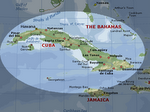
On Cuban compensation for US nationalized properties
Posted by: "NPV" nvaldes@unm.edu
Mon May 25, 2009 4:53 pm (PDT)
On the matter of Cuban compensation for US properties -
It is important to consider the issues from each side of the conflict:
1. Cuba offered to pay compensation in 1960 to all foreign companies.
However, the Cuban position was that the compensation formula would be
similar to what the United States government did at the time that the US
military took over Japan in 1945. At that time the United States government
assumed that in order to have a political democracy in Japan it was
necessary to carry out an agrarian reform diminishing the economic (and
hence political power) of the landlords. The agrarian reform established by
the US had a compensation formula by which 1/3 of the value of the landed
property would be paid in cash and immediately, 1/3 would be paid in
installments during a 30 year period, and the last 1/3 would be paid in cash
[with interest] at the end of a 30 year period. The Cuban government adopted
a similar formula for US properties.
2. The US government, on the other hand, demanded that Cuba pay "in cash,
adequate and prompt" compensation. Adequate meant - pay what the owners of
the properties say the property is worth. Prompt meant pay all of the
compensation immediately. Finally, in cash meant that it should not be in
bonds, securities, etc.
3. The past issue that should be considered: the formula to determine the
worth of the property. The Cuban government maintained that the value of a
property should be determined on the basis of what the owners said the
property was worth for purposes of taxation throughout the 1950s. As a rule,
foreign investors undervalued their properties in order to pay fewer taxes
on a yearly basis. The Cuban government maintained that that would be the
figure that the state would accept; the US property owners disagreed. The
Cuban authorities offered to pay the worth that the owners claimed, but then
the owners had to pay back taxes (plus a penalty and interest). the United
States government considered such formula unacceptable.
The Cuban government also offered to establish a special fund for purposes
of compensation stemming from the sale of sugar to the United States. The
US government did not accept that proposal.
The majority of the US companies declared their investments in Cuba as
losses and consequently deducted their declared value to the IRS.
Nelson P Valdes
Monday, May 25, 2009
Property Compensation Claims
US-Cuba thaw may mean compensation for lost assets
Created 25/05/2009 - 16:45
SOURCE: AP
After 47 years, Mario Sanchez's memory of the house near the Havana Zoo where he was born has faded.But he has not forgotten the address, and can look at the roof using satellite imaging on his computer at his Florida home, 370km away.
"My hope and dream is that one day I would be able to have my property returned to me," Sanchez, a computer science professor at Miami Dade Community College, said in a telephone interview.
With the prospect of improved relations between the United States and Cuba, Sanchez believes that day may no longer be so far off.
He's not alone. Some US companies and Cuban-Americans still hope to recover ownership or compensation for what they lost in the early 1960s, when Fidel Castro nationalized factories, farms, hotels, office towers, department stores, mills, mines, farmland and homes - the largest seizure of American-owned property in history.
The Obama administration's overtures to Havana, its easing of some facets of the 47-year-old trade embargo, and the Cuban government's willingness to discuss improved relations have kindled hope for settlements.
"It's early yet, but I'm optimistic," said Robert Muse, a Washington attorney who represents two of the largest claimants to certify lost property with the US Department of Justice.
"Any warming trend is positive because these claims can't be resolved in absence of rapprochement with Cuba."
Muse, who asked that his clients not be named in print, said international law recognizes the right of foreign owners to seek compensation for seized property.
In 1972, nearly 6000 American companies and individuals who were US citizens at the time their property was confiscated filed claims with the US government for property then worth more than $US1.8 billion and estimated to now be worth around $US7 billion.
Claimants include General Electric, General Motors, Ford, Sears, Coke, Pepsi, Citicorp and Goodyear. Texaco lost its refinery in the eastern city of Santiago. ITT was stripped of its stake in Cuba's phone company.
None of the numerous US companies contacted for this story would comment on claims, citing legal constraints.
But Muse said the "claims remain assets on the books of the companies."
The 10 largest claimants are US companies accounting for nearly $US1 billion of the original losses, he said.
But they are unlikely to want their assets back after years of neglect, and may settle instead for receiving special incentives to invest in the island if controls are lifted, Muse said.
"Companies are willing to be creative and innovative in settling," he said in a telephone interview.
Cuba also expropriated property belonging to hundreds of non-US firms and has signed compensation agreements with Canada, Switzerland, France, Great Britain, Spain and Mexico.
The US negotiated settlements for American property lost to Vietnam's communist government, to Iran after its Islamic revolution and to Eastern European countries that went communist after World War 2.
But not Cuba. In 1960 Castro's government offered compensation in bonds or sugar exports to the US but American authorities say that would have required their country to buy huge amounts of sugar at inflated prices.
A year later the US imposed the embargo and froze Cuban government accounts in American banks. At the end of 2005, the US Treasury Department said $US268.3 million remained, though how much is still there today is unclear.
Some of that money went to families who sued Cuba in American courts under a 1996 law allowing victims of terrorist groups or countries that sponsor them to seek damages.
Cuba has long said it is willing to compensate US interests but wants restitution for the embargo's economic damage, which it calculates at $US93 billion.
The Cuban government is less willing to pay for property lost by Cubans who later became US citizens.
That group includes Sanchez, the computer science professor, who was smuggled off the island at age 6 and didn't see his parents for six more years.
His family's land, home and beach house were seized when officials forced his father, the owner of a transportation company, to work for the new Castro government as a logistical consultant.
Now 53, Sanchez holds deeds to both homes and can still reel off his exact address in Havana's Nuevo Vedado neighbourhood: "Oeste 818 between Conill and Santa Ana Streets."
From what he sees on the satellite images, "The roof looks good." "I would have no problem living there," he said.
But some say it's impossible to turn back the clock.
"Finding out what belongs to who is going to be very hard. Too hard," said Clara Del Valle, 65, a descendant of the Bacardi family whose rum empire had to leave Cuba after Castro took over.
She is vice chairwoman of the Cuban-American National Foundation, an anti-Castro group.
Sanchez's house is an example of the difficulties that may lie ahead.
It looks unchanged from the fashionable one-story home in a black-and-white 1950s photo that Sanchez has, but is occupied by 80-year-old Iliana Paz and her daughter and son-in-law.
"This is my world," Paz said.
A retired attendant at a military mess hall, Paz said she lived in a decrepit apartment building until she moved into the house 42 years ago.
She said Sanchez's mother asked her to care for it until her return. She gave the mother's full name without prompting, saying that this proved she was in the home legally.
But Sanchez said he has never heard of Paz and that his mother, now deceased, never said anything about such instructions.
Also, Paz's account has inconsistencies, and neighbours suggest the house is controlled by the government, which decides who can live there.
Sanchez said he doesn't want to displace anyone.
"How do you deal with people who have been living in your house for 40 years?" he asked. "Do you throw them out on the street? You can't do it." Paz said she won't let him.
"Nothing can make me move," she vowed. "Nothing, nothing, nothing."
Source URL (retrieved on 26/05/2009 - 06:35): http://www.odt.co.nz/news/world/57892/us-cuba-thaw-may-mean-compensation-lost-assets
Created 25/05/2009 - 16:45
SOURCE: AP
After 47 years, Mario Sanchez's memory of the house near the Havana Zoo where he was born has faded.But he has not forgotten the address, and can look at the roof using satellite imaging on his computer at his Florida home, 370km away.
"My hope and dream is that one day I would be able to have my property returned to me," Sanchez, a computer science professor at Miami Dade Community College, said in a telephone interview.
With the prospect of improved relations between the United States and Cuba, Sanchez believes that day may no longer be so far off.
He's not alone. Some US companies and Cuban-Americans still hope to recover ownership or compensation for what they lost in the early 1960s, when Fidel Castro nationalized factories, farms, hotels, office towers, department stores, mills, mines, farmland and homes - the largest seizure of American-owned property in history.
The Obama administration's overtures to Havana, its easing of some facets of the 47-year-old trade embargo, and the Cuban government's willingness to discuss improved relations have kindled hope for settlements.
"It's early yet, but I'm optimistic," said Robert Muse, a Washington attorney who represents two of the largest claimants to certify lost property with the US Department of Justice.
"Any warming trend is positive because these claims can't be resolved in absence of rapprochement with Cuba."
Muse, who asked that his clients not be named in print, said international law recognizes the right of foreign owners to seek compensation for seized property.
In 1972, nearly 6000 American companies and individuals who were US citizens at the time their property was confiscated filed claims with the US government for property then worth more than $US1.8 billion and estimated to now be worth around $US7 billion.
Claimants include General Electric, General Motors, Ford, Sears, Coke, Pepsi, Citicorp and Goodyear. Texaco lost its refinery in the eastern city of Santiago. ITT was stripped of its stake in Cuba's phone company.
None of the numerous US companies contacted for this story would comment on claims, citing legal constraints.
But Muse said the "claims remain assets on the books of the companies."
The 10 largest claimants are US companies accounting for nearly $US1 billion of the original losses, he said.
But they are unlikely to want their assets back after years of neglect, and may settle instead for receiving special incentives to invest in the island if controls are lifted, Muse said.
"Companies are willing to be creative and innovative in settling," he said in a telephone interview.
Cuba also expropriated property belonging to hundreds of non-US firms and has signed compensation agreements with Canada, Switzerland, France, Great Britain, Spain and Mexico.
The US negotiated settlements for American property lost to Vietnam's communist government, to Iran after its Islamic revolution and to Eastern European countries that went communist after World War 2.
But not Cuba. In 1960 Castro's government offered compensation in bonds or sugar exports to the US but American authorities say that would have required their country to buy huge amounts of sugar at inflated prices.
A year later the US imposed the embargo and froze Cuban government accounts in American banks. At the end of 2005, the US Treasury Department said $US268.3 million remained, though how much is still there today is unclear.
Some of that money went to families who sued Cuba in American courts under a 1996 law allowing victims of terrorist groups or countries that sponsor them to seek damages.
Cuba has long said it is willing to compensate US interests but wants restitution for the embargo's economic damage, which it calculates at $US93 billion.
The Cuban government is less willing to pay for property lost by Cubans who later became US citizens.
That group includes Sanchez, the computer science professor, who was smuggled off the island at age 6 and didn't see his parents for six more years.
His family's land, home and beach house were seized when officials forced his father, the owner of a transportation company, to work for the new Castro government as a logistical consultant.
Now 53, Sanchez holds deeds to both homes and can still reel off his exact address in Havana's Nuevo Vedado neighbourhood: "Oeste 818 between Conill and Santa Ana Streets."
From what he sees on the satellite images, "The roof looks good." "I would have no problem living there," he said.
But some say it's impossible to turn back the clock.
"Finding out what belongs to who is going to be very hard. Too hard," said Clara Del Valle, 65, a descendant of the Bacardi family whose rum empire had to leave Cuba after Castro took over.
She is vice chairwoman of the Cuban-American National Foundation, an anti-Castro group.
Sanchez's house is an example of the difficulties that may lie ahead.
It looks unchanged from the fashionable one-story home in a black-and-white 1950s photo that Sanchez has, but is occupied by 80-year-old Iliana Paz and her daughter and son-in-law.
"This is my world," Paz said.
A retired attendant at a military mess hall, Paz said she lived in a decrepit apartment building until she moved into the house 42 years ago.
She said Sanchez's mother asked her to care for it until her return. She gave the mother's full name without prompting, saying that this proved she was in the home legally.
But Sanchez said he has never heard of Paz and that his mother, now deceased, never said anything about such instructions.
Also, Paz's account has inconsistencies, and neighbours suggest the house is controlled by the government, which decides who can live there.
Sanchez said he doesn't want to displace anyone.
"How do you deal with people who have been living in your house for 40 years?" he asked. "Do you throw them out on the street? You can't do it." Paz said she won't let him.
"Nothing can make me move," she vowed. "Nothing, nothing, nothing."
Source URL (retrieved on 26/05/2009 - 06:35): http://www.odt.co.nz/news/world/57892/us-cuba-thaw-may-mean-compensation-lost-assets
Friday, May 22, 2009
Interest in Cuban Bonds
New U.S.-Cuba relations fuel investor interest
Fri May 22, 2009 2:59pm EDT
By Manuela Badawy - Analysis
NEW YORK (Reuters) - Investors in high risk assets are setting their sights on Cuban securities now more than ever given the cheap prices and the overtures made by the U.S. government toward the island.
Since U.S. President Barack Obama pledged to recast U.S.-Cuba ties in April, investors in high risk bonds have shown interest in Cuban securities as a means to accessing a market that has been closed to U.S. capital for almost half a century and is ripe for investment.
The extremely illiquid Cuban paper had halved in price to single digits by the end of 2008 when the global economy spiraled down and investors moved their money away from risky markets into safe-haven assets.
Thus, with Cuban assets valued at around 8 cents to the U.S. dollar high-risk investors see the latest U.S.-Cuba policy move as a reason to get into the Cuban securities market.
"The conditions in the U.S., with the arrival of the Obama administration, and in Cuba, with the move to economic reform in the last three years, are driving people to be very interested in the Cuban story," said Stuart Culverhouse, chief economist at Exotix, a London-based brokerage firm specialized in illiquid bonds and loans of emerging markets.
The U.S. government in April eased restrictions on Cuban American travel, and remittances to Cuba, and on U.S. telecommunications business with the island. But the Obama administration urged Cuba to reciprocate by releasing detained dissidents and allowing greater political freedom.
Experts say the conciliatory gestures need to evolve into a full lifting of the embargo which would help to improve the quality of life for Cubans by opening the country to trade and foreign investment.
"This would also facilitate bilateral trade opportunities with the U.S., an invaluable market for any exporting nation," said Lilly Briger, research associate at the Council on Hemispheric Affairs.
Energy, tourism, infrastructure and mining are just some of the sectors prime for development. Companies from Canada, Europe, China and other countries are already reaping rewards, while U.S. investors are still locked out by the embargo.
If the embargo on trade and investment restrictions were to be lifted by the United States in the coming years, Cuba would see an avalanche of money by creditors and U.S. investors.
In 1986 Cuba stopped servicing bank loans it took in the 1960s and 1970s to finance industrialization. The original principle was around $1 billion, but since the Caribbean government has not paid interest on the defaulted debt, the amount outstanding is already over $3 billion.
These defaulted commercial loans, often referred as London Club debt, are still held by a few European investors who trade on the expectation that Cuba will have to reach an agreement with their external creditors in order to access capital in the future.
"Investors are persuaded by the Cuban story, and if that is so then there will be a recovery on the paper," Culverhouse said adding that the loan used to trade 20 cents on the dollar in 2007.
However, the embargo is likely to remain in place as long as Raul and Fidel Castro stay at the helm of the island or unless they make some drastic changes, said Heather Berkman, Latin America analyst at Eurasia Group in Washington, D.C.
Yet, there is a lot of opportunity in Cuba given that there's so much interest among American investors and that the island has been blocked for so long.
Fri May 22, 2009 2:59pm EDT
By Manuela Badawy - Analysis
NEW YORK (Reuters) - Investors in high risk assets are setting their sights on Cuban securities now more than ever given the cheap prices and the overtures made by the U.S. government toward the island.
Since U.S. President Barack Obama pledged to recast U.S.-Cuba ties in April, investors in high risk bonds have shown interest in Cuban securities as a means to accessing a market that has been closed to U.S. capital for almost half a century and is ripe for investment.
The extremely illiquid Cuban paper had halved in price to single digits by the end of 2008 when the global economy spiraled down and investors moved their money away from risky markets into safe-haven assets.
Thus, with Cuban assets valued at around 8 cents to the U.S. dollar high-risk investors see the latest U.S.-Cuba policy move as a reason to get into the Cuban securities market.
"The conditions in the U.S., with the arrival of the Obama administration, and in Cuba, with the move to economic reform in the last three years, are driving people to be very interested in the Cuban story," said Stuart Culverhouse, chief economist at Exotix, a London-based brokerage firm specialized in illiquid bonds and loans of emerging markets.
The U.S. government in April eased restrictions on Cuban American travel, and remittances to Cuba, and on U.S. telecommunications business with the island. But the Obama administration urged Cuba to reciprocate by releasing detained dissidents and allowing greater political freedom.
Experts say the conciliatory gestures need to evolve into a full lifting of the embargo which would help to improve the quality of life for Cubans by opening the country to trade and foreign investment.
"This would also facilitate bilateral trade opportunities with the U.S., an invaluable market for any exporting nation," said Lilly Briger, research associate at the Council on Hemispheric Affairs.
Energy, tourism, infrastructure and mining are just some of the sectors prime for development. Companies from Canada, Europe, China and other countries are already reaping rewards, while U.S. investors are still locked out by the embargo.
If the embargo on trade and investment restrictions were to be lifted by the United States in the coming years, Cuba would see an avalanche of money by creditors and U.S. investors.
In 1986 Cuba stopped servicing bank loans it took in the 1960s and 1970s to finance industrialization. The original principle was around $1 billion, but since the Caribbean government has not paid interest on the defaulted debt, the amount outstanding is already over $3 billion.
These defaulted commercial loans, often referred as London Club debt, are still held by a few European investors who trade on the expectation that Cuba will have to reach an agreement with their external creditors in order to access capital in the future.
"Investors are persuaded by the Cuban story, and if that is so then there will be a recovery on the paper," Culverhouse said adding that the loan used to trade 20 cents on the dollar in 2007.
However, the embargo is likely to remain in place as long as Raul and Fidel Castro stay at the helm of the island or unless they make some drastic changes, said Heather Berkman, Latin America analyst at Eurasia Group in Washington, D.C.
Yet, there is a lot of opportunity in Cuba given that there's so much interest among American investors and that the island has been blocked for so long.
Monday, May 18, 2009
Reuters and Economist Intelligence Unit on 10% $ surcharge
Cuba Dollar Tax Reveals Complexity of Trade Embargo
By MARC FRANK
HAVANA, Cuba, May 15, 2009
If you stand lookout from the housing projects along the back highway to Havana's Jose Marti International Airport, you will eventually witness a motorcade of Transval (Cuba's Brinks) armored vehicles speeding toward the airport, surrounded by the flashing lights of police cars and motorcycle cops.
Cuba's government is moving cash, mainly U.S. dollars, to somewhere on the planet where a bank has agreed to process the bills for a few percentage points above normal exchange rates.
Americans, unlike tourists from other countries, cannot use credit cards drawn from U.S. banks in Cuba. Americans must use cash, because Cuban banks are prohibited from any banking relations with their U.S. counterparts. The catch 22: Under the U.S. trade embargo, it is also illegal for Cuba to use dollars or for anyone anywhere to do business with the country in U.S. currency.
"The U.S. embargo prohibits Cuba from using dollars for any reason. Therefore, remittances come here, American travelers come here, it doesn't matter who it is with dollars, they change them into Cuban money," said Kirby Jones, president of the Washington-based Alamar Associates, which consults on doing business with Cuba and the embargo.
"Cuba can't use these dollars, they have to change the dollars somehow into other currencies, and that costs money."
The White House has expressed concern about a 10 percent tax on U.S. dollars entering Cuba ever since President Barack Obama last month lifted restrictions on Cuban-Americans visiting the island and sending funds to relatives. If legislation in Congress allowing all Americans to travel to Cuba becomes law, the dollar tax no doubt will become even more of an issue.
"They could reduce charges on remittances to match up with the policies that we have put in place to allow Cuban-American families to send remittances. It turns out that Cuba charges an awful lot, they take a lot off the top," Obama said at the close of the Summit of the Americas last month in Trinidad and Tobago.
"That would be an example of cooperation where both governments are working to help Cuban families and raise standards of living in Cuba," he said.
The U.S. Embargo Is Like "A Big Bowl of Spaghetti"?
If only the life and the trade embargo were that simple. … The dollar motorcade holds the key to why it is not.
The dollar became legal tender in Cuba alongside the peso back in 1993 after the fall of the Soviet Union plunged the Communist-run island into economic crisis and forced it to open up to Cuban Americans, tourism and foreign investment.
Dollars became the dominant currency and were used to buy many consumer goods in state-run dollar stores.
The Clinton administration apparently looked the other way. The Bush administration decided to enforce the rules.
In May 2004 the U.S. Federal Reserve fined UBS, Switzerland's largest bank, $100 million for illegally dealing in dollars with Cuba, after congressional embargo proponents leveled charges of money laundering, and the Bush administration threatened to pursue Cuban dollars wherever they might find a new home.
The Cuban dollars did not come from drug trafficking, gambling or other criminal activity. They came mainly from Americans, mostly of Cuban descent, who visited or sent funds to family and friends.
Cuba retaliated by replacing the dollar with its own currency, called the convertible peso, which it said was worth $1.08. It then slapped a 10 percent exchange tax on dollars entering the country. That meant a whopping 18 percent exchange charge for convertible pesos, plus a processing fee, or around 20 percent.
The issue, according to the White House, was discussed during informal talks with Cuba in Washington, but it is hard to imagine Havana dropping the tax unless Washington allows it to use U.S. dollars. Government sources report the flow of dollars into the country has declined significantly in favor of euros, Canadian dollars and other currencies.
Housing project residents confirm there are fewer armored trucks and motorcades these days.
Maite, a 28-year-old housewife, was one of a group of women last Sunday cleaning house, watching the kids and chatting together.
"I love Obama," Maite, of African-Cuban descent beamed, to nods all around.
"But I think it is going to be very hard to undo everything that has happened over the last 50 years," she said, the smile becoming a pout. "Everything has become so tangled. It is like a big bowl of spaghetti."
When Will the Embargo Loosen?
Indeed, loosening the embargo piece-by-piece is better than nothing, said Alamar's Jones, who opposes the embargo. But it sure can get complicated.
"When Carter lifted the travel ban in 1977 they didn't realize it raised other issues, for example credit cards, insurance, all sorts of issues associated with travel that had nothing to do with a person going from A to B," Jones said.
So if travel opens up how do people pay? Not with their Visa card or Mastercard if they were issued by U.S. banks. So there will be a need to allow direct banking relations, and that means the dollar tax, which is only on cash, will not apply. But if for travel, why not for U.S. food sales that now must go through third country banks?"
Under a 2000 amendment to the embargo, Cuba can purchase food for cash, and bought than $700 million worth last year. But embargo rules on direct bank relations and dollar use remain.
The Cubans therefore must first turn dollars into another currency and put them in a third country bank, which then changes the money back to dollars to pay cash for the food, absorbing the exchange fees.
"Any measure raises other issues related to the embargo, which raises other issues and then more issues," Jones said of the dollar tax squabble.
"It's like a sweater. You pull a thread and stuff just begins to unravel."
******************
Economist Intelligence Unit, Cuba Country Report, November 2004 pp 18-19
The most important development in economic policy during the past quarter
has been the ending of the use of US dollars in the domestic economy. News of
the change came on October 25th in a televised announcement by the
president, Fidel Castro, that dollars were to be withdrawn from circulation.
Banco Central de Cuba (the Central Bank) legislation setting out the new rules
was dated October 23rd, but before the decision was made public the news
was communicated, in confidence, to the staff who would need to manage the
transition in banks and retail outlets.
Since the legalisation of the holding of US dollars in 1993, dollars have been the
medium of exchange for most retail sales outside the ration system. In 1994, a
Cuban currency, known as the peso convertible (PC, the convertible peso), was
introduced at par with the US dollar, and this has circulated freely alongside the
dollar since then. The announcement stated that from November 8th only the
convertible peso would be accepted in dollar retail outlets. For dollar-holders,
the move would not change the value of their money nor restrict access to
goods sold in the dollar shops if dollars were exchanged for convertible pesos
by November 8th, but any exchange of dollars for convertible pesos after that
date would carry a 10% commission. The deadline for changing currencies
before the imposition of the 10% charge was subsequently extended by one
week, to November 14th.
The move came as a surprise to the Cuban public, although it appears to have
been carefully planned. It was presented as a direct response to US measures,
referring to the US administration’s drive to strengthen the implementation of
US sanctions legislation that forbids the use of US dollars for transactions with
Cuba. This provision of US law has been in place since 1963, but Cuba has
found ways to convert its dollars for other hard currencies by exploiting the
difficulties of policing it. However, the US authorities have stepped up efforts to
enforce its sanctions, and in May the Federal Reserve (the US Central Bank)
successfully prosecuted a Swiss bank, UBS, for providing exchange services
involving US dollars to Cuba and three other countries subject to US sanctions,
Libya, Iran and Yugoslavia: a fine of US$100m was imposed. This has served to
deter other banks from exchanging US dollars held by Cuban entities, evidently
making it more difficult for Cuban entities to use their dollars and so increasing
the cost of Cuba’s international transactions. By encouraging tourists and
senders of remittances to use currencies other than the US dollar, the Cuban
banking system is therefore circumventing the US restrictions and reducing costs.
By MARC FRANK
HAVANA, Cuba, May 15, 2009
If you stand lookout from the housing projects along the back highway to Havana's Jose Marti International Airport, you will eventually witness a motorcade of Transval (Cuba's Brinks) armored vehicles speeding toward the airport, surrounded by the flashing lights of police cars and motorcycle cops.
Cuba's government is moving cash, mainly U.S. dollars, to somewhere on the planet where a bank has agreed to process the bills for a few percentage points above normal exchange rates.
Americans, unlike tourists from other countries, cannot use credit cards drawn from U.S. banks in Cuba. Americans must use cash, because Cuban banks are prohibited from any banking relations with their U.S. counterparts. The catch 22: Under the U.S. trade embargo, it is also illegal for Cuba to use dollars or for anyone anywhere to do business with the country in U.S. currency.
"The U.S. embargo prohibits Cuba from using dollars for any reason. Therefore, remittances come here, American travelers come here, it doesn't matter who it is with dollars, they change them into Cuban money," said Kirby Jones, president of the Washington-based Alamar Associates, which consults on doing business with Cuba and the embargo.
"Cuba can't use these dollars, they have to change the dollars somehow into other currencies, and that costs money."
The White House has expressed concern about a 10 percent tax on U.S. dollars entering Cuba ever since President Barack Obama last month lifted restrictions on Cuban-Americans visiting the island and sending funds to relatives. If legislation in Congress allowing all Americans to travel to Cuba becomes law, the dollar tax no doubt will become even more of an issue.
"They could reduce charges on remittances to match up with the policies that we have put in place to allow Cuban-American families to send remittances. It turns out that Cuba charges an awful lot, they take a lot off the top," Obama said at the close of the Summit of the Americas last month in Trinidad and Tobago.
"That would be an example of cooperation where both governments are working to help Cuban families and raise standards of living in Cuba," he said.
The U.S. Embargo Is Like "A Big Bowl of Spaghetti"?
If only the life and the trade embargo were that simple. … The dollar motorcade holds the key to why it is not.
The dollar became legal tender in Cuba alongside the peso back in 1993 after the fall of the Soviet Union plunged the Communist-run island into economic crisis and forced it to open up to Cuban Americans, tourism and foreign investment.
Dollars became the dominant currency and were used to buy many consumer goods in state-run dollar stores.
The Clinton administration apparently looked the other way. The Bush administration decided to enforce the rules.
In May 2004 the U.S. Federal Reserve fined UBS, Switzerland's largest bank, $100 million for illegally dealing in dollars with Cuba, after congressional embargo proponents leveled charges of money laundering, and the Bush administration threatened to pursue Cuban dollars wherever they might find a new home.
The Cuban dollars did not come from drug trafficking, gambling or other criminal activity. They came mainly from Americans, mostly of Cuban descent, who visited or sent funds to family and friends.
Cuba retaliated by replacing the dollar with its own currency, called the convertible peso, which it said was worth $1.08. It then slapped a 10 percent exchange tax on dollars entering the country. That meant a whopping 18 percent exchange charge for convertible pesos, plus a processing fee, or around 20 percent.
The issue, according to the White House, was discussed during informal talks with Cuba in Washington, but it is hard to imagine Havana dropping the tax unless Washington allows it to use U.S. dollars. Government sources report the flow of dollars into the country has declined significantly in favor of euros, Canadian dollars and other currencies.
Housing project residents confirm there are fewer armored trucks and motorcades these days.
Maite, a 28-year-old housewife, was one of a group of women last Sunday cleaning house, watching the kids and chatting together.
"I love Obama," Maite, of African-Cuban descent beamed, to nods all around.
"But I think it is going to be very hard to undo everything that has happened over the last 50 years," she said, the smile becoming a pout. "Everything has become so tangled. It is like a big bowl of spaghetti."
When Will the Embargo Loosen?
Indeed, loosening the embargo piece-by-piece is better than nothing, said Alamar's Jones, who opposes the embargo. But it sure can get complicated.
"When Carter lifted the travel ban in 1977 they didn't realize it raised other issues, for example credit cards, insurance, all sorts of issues associated with travel that had nothing to do with a person going from A to B," Jones said.
So if travel opens up how do people pay? Not with their Visa card or Mastercard if they were issued by U.S. banks. So there will be a need to allow direct banking relations, and that means the dollar tax, which is only on cash, will not apply. But if for travel, why not for U.S. food sales that now must go through third country banks?"
Under a 2000 amendment to the embargo, Cuba can purchase food for cash, and bought than $700 million worth last year. But embargo rules on direct bank relations and dollar use remain.
The Cubans therefore must first turn dollars into another currency and put them in a third country bank, which then changes the money back to dollars to pay cash for the food, absorbing the exchange fees.
"Any measure raises other issues related to the embargo, which raises other issues and then more issues," Jones said of the dollar tax squabble.
"It's like a sweater. You pull a thread and stuff just begins to unravel."
******************
Economist Intelligence Unit, Cuba Country Report, November 2004 pp 18-19
The most important development in economic policy during the past quarter
has been the ending of the use of US dollars in the domestic economy. News of
the change came on October 25th in a televised announcement by the
president, Fidel Castro, that dollars were to be withdrawn from circulation.
Banco Central de Cuba (the Central Bank) legislation setting out the new rules
was dated October 23rd, but before the decision was made public the news
was communicated, in confidence, to the staff who would need to manage the
transition in banks and retail outlets.
Since the legalisation of the holding of US dollars in 1993, dollars have been the
medium of exchange for most retail sales outside the ration system. In 1994, a
Cuban currency, known as the peso convertible (PC, the convertible peso), was
introduced at par with the US dollar, and this has circulated freely alongside the
dollar since then. The announcement stated that from November 8th only the
convertible peso would be accepted in dollar retail outlets. For dollar-holders,
the move would not change the value of their money nor restrict access to
goods sold in the dollar shops if dollars were exchanged for convertible pesos
by November 8th, but any exchange of dollars for convertible pesos after that
date would carry a 10% commission. The deadline for changing currencies
before the imposition of the 10% charge was subsequently extended by one
week, to November 14th.
The move came as a surprise to the Cuban public, although it appears to have
been carefully planned. It was presented as a direct response to US measures,
referring to the US administration’s drive to strengthen the implementation of
US sanctions legislation that forbids the use of US dollars for transactions with
Cuba. This provision of US law has been in place since 1963, but Cuba has
found ways to convert its dollars for other hard currencies by exploiting the
difficulties of policing it. However, the US authorities have stepped up efforts to
enforce its sanctions, and in May the Federal Reserve (the US Central Bank)
successfully prosecuted a Swiss bank, UBS, for providing exchange services
involving US dollars to Cuba and three other countries subject to US sanctions,
Libya, Iran and Yugoslavia: a fine of US$100m was imposed. This has served to
deter other banks from exchanging US dollars held by Cuban entities, evidently
making it more difficult for Cuban entities to use their dollars and so increasing
the cost of Cuba’s international transactions. By encouraging tourists and
senders of remittances to use currencies other than the US dollar, the Cuban
banking system is therefore circumventing the US restrictions and reducing costs.
Sunday, April 12, 2009
Oakland Pastor Supports Black Caucus Trip
Policy Toward Cuba that was Once Radical is now Logical
Byron Williams
Columnist, pastor of the Resurrection Community Church Oakland, CA
Posted April 12, 2009 | 11:25 AM (EST)
Huffington Post
http://www.huffingtonpost.com/byron-williams/policy-toward-cuba-that-w_b_185960.html
What is it about the congressional seat that represents Oakland and Berkeley? Is there some radical potion that one consumes before occupying it?
Though radical tends to carry a definition of being an extremist, it is often a term given by the dominant culture because of the discomfort created by the proposed change.
Sometimes radical is simply running ahead of contemporary thinking, pushing the envelope until others catch up. Radical today can be the status quo tomorrow.
The decades that former Rep. Ron Dellums carried the South African sanctions bill looked radical to many before it finally passed in 1986. Today, the Comprehensive Anti-Apartheid Act of 1986 is viewed as critical to speeding the process of ending the suffocating conditions of apartheid as well as the release of Nelson Mandela.
In that same tradition, Rep Barbara Lee, D-Oakland, and current chairwoman of the Congressional Black Caucus, led a delegation on a visit to Cuba, which included a meeting with former President Fidel Castro, to discuss proposed relaxing travel and financial restrictions.
For 50 years, any challenge to lifting the United States' economic embargoes toward Cuba has been viewed as radical. How radical is it to put an end to a policy that has not worked, based on Cold War thinking that no longer exist?
I am aware of the arguments against normalizing relations with Cuba, it could open a virtual Pandora's box of dictatorships spreading throughout Latin America. Doesn't that echo with the hollow ring of the "Domino Theory?"
Moreover, it assumes that Castro overthrew a paragon of democratic values in Fulgencio Batista in 1959. In 1954, Vice President Richard Nixon visited Havana to congratulate Batista on the winning an election in which his was the only name that appeared on the ballot.
But unlike Batista, Castro showed little interest in bending to the political will of the United States, which was more of a problem than ideology. But even President Kennedy saw the virtue of normalizing relations with Cuba in 1963, despite of the CIA's Operation Mongoose. Opponents to normalizing Cuban relations also cite its human rights record, which includes limiting freedoms of expression, assembly, the press; it's lack of due process and arbitrary imprisonments.
It's not as if the United States' foreign policy historically has been averse to supporting dictators in Latin America. U.S. support for individuals such as Augusto Pinochet and Anatasio Somoza may have been the necessary cost for America to maintain its sphere of influence in the region during the Cold War, but in retrospect it was propping up murderous dictators.
But as Lee said to me during our interview, "We can't let this moment pass by. The climate is definitely changing."
Not that long ago, it would have been inconceivable to imagine an official congressional delegation meeting with Castro, with the blessings of the Speaker of the House.
Nontraditional bedfellows from Amnesty International to the U.S. Chamber of Commerce have coalesced in support of ending a policy that has had five decades and 10 presidents to prove beyond any doubt to be a miserable failure.
Economic trade can do more to alter Cuban politics internally than anything achieved by staying the present course.
There are trading opportunities between Cuba and the U.S. that cannot happen as a result of the existing policies. Lee, whose district includes a number of biotech firms, told me about the advances Cuba has made in this area that could be beneficial to America.
According to Lee, "This is a trading relationship that Cuba wants. It's closer. The prices are better, the quality. So they want to buy American.
"Why in the world are we keeping our business from profiting from the Cuban market? It just doesn't make sense."
Lee's right; it doesn't make sense. But making sense is not always the criterion that drives U.S. foreign policy. The Cold War that fueled the current Cuban policy ended in 1991. What's driving the policy now?
Lee's leadership informs us that what was impossible in the '60s and '70s, radical in the '90s, is now simply the next logical step in a 50-year odyssey that has accomplished very little outside of political pandering.
Byron Williams
Columnist, pastor of the Resurrection Community Church Oakland, CA
Posted April 12, 2009 | 11:25 AM (EST)
Huffington Post
http://www.huffingtonpost.com/byron-williams/policy-toward-cuba-that-w_b_185960.html
What is it about the congressional seat that represents Oakland and Berkeley? Is there some radical potion that one consumes before occupying it?
Though radical tends to carry a definition of being an extremist, it is often a term given by the dominant culture because of the discomfort created by the proposed change.
Sometimes radical is simply running ahead of contemporary thinking, pushing the envelope until others catch up. Radical today can be the status quo tomorrow.
The decades that former Rep. Ron Dellums carried the South African sanctions bill looked radical to many before it finally passed in 1986. Today, the Comprehensive Anti-Apartheid Act of 1986 is viewed as critical to speeding the process of ending the suffocating conditions of apartheid as well as the release of Nelson Mandela.
In that same tradition, Rep Barbara Lee, D-Oakland, and current chairwoman of the Congressional Black Caucus, led a delegation on a visit to Cuba, which included a meeting with former President Fidel Castro, to discuss proposed relaxing travel and financial restrictions.
For 50 years, any challenge to lifting the United States' economic embargoes toward Cuba has been viewed as radical. How radical is it to put an end to a policy that has not worked, based on Cold War thinking that no longer exist?
I am aware of the arguments against normalizing relations with Cuba, it could open a virtual Pandora's box of dictatorships spreading throughout Latin America. Doesn't that echo with the hollow ring of the "Domino Theory?"
Moreover, it assumes that Castro overthrew a paragon of democratic values in Fulgencio Batista in 1959. In 1954, Vice President Richard Nixon visited Havana to congratulate Batista on the winning an election in which his was the only name that appeared on the ballot.
But unlike Batista, Castro showed little interest in bending to the political will of the United States, which was more of a problem than ideology. But even President Kennedy saw the virtue of normalizing relations with Cuba in 1963, despite of the CIA's Operation Mongoose. Opponents to normalizing Cuban relations also cite its human rights record, which includes limiting freedoms of expression, assembly, the press; it's lack of due process and arbitrary imprisonments.
It's not as if the United States' foreign policy historically has been averse to supporting dictators in Latin America. U.S. support for individuals such as Augusto Pinochet and Anatasio Somoza may have been the necessary cost for America to maintain its sphere of influence in the region during the Cold War, but in retrospect it was propping up murderous dictators.
But as Lee said to me during our interview, "We can't let this moment pass by. The climate is definitely changing."
Not that long ago, it would have been inconceivable to imagine an official congressional delegation meeting with Castro, with the blessings of the Speaker of the House.
Nontraditional bedfellows from Amnesty International to the U.S. Chamber of Commerce have coalesced in support of ending a policy that has had five decades and 10 presidents to prove beyond any doubt to be a miserable failure.
Economic trade can do more to alter Cuban politics internally than anything achieved by staying the present course.
There are trading opportunities between Cuba and the U.S. that cannot happen as a result of the existing policies. Lee, whose district includes a number of biotech firms, told me about the advances Cuba has made in this area that could be beneficial to America.
According to Lee, "This is a trading relationship that Cuba wants. It's closer. The prices are better, the quality. So they want to buy American.
"Why in the world are we keeping our business from profiting from the Cuban market? It just doesn't make sense."
Lee's right; it doesn't make sense. But making sense is not always the criterion that drives U.S. foreign policy. The Cold War that fueled the current Cuban policy ended in 1991. What's driving the policy now?
Lee's leadership informs us that what was impossible in the '60s and '70s, radical in the '90s, is now simply the next logical step in a 50-year odyssey that has accomplished very little outside of political pandering.
Monday, March 9, 2009
2007 Defeat of Rangel Amendment
Vote Rejects Efforts To Ease Cuba Trade Restrictions
By DAVID ROGERS
Wall Street Journal
July 30, 2007
Anti-Castro lawmakers in Congress are delighted by a House vote last week rejecting efforts to ease restrictions on financing for U.S. agricultural exports to Cuba.
The 245-182 vote quashes speculation that the new Democratic Congress will change U.S.-Cuban policy substantially.
Rep. Debbie Wasserman Schultz (D., Fla.), a favorite of her party leaders, helped deliver 66 Democratic votes against an amendment sponsored by the House's chief tax writer, Ways and Means Committee Chairman Charles Rangel (D., N.Y.).
"The message is very clear," said Rep. Lincoln Diaz-Balart (R., Fla.). "There will be no possibility of a relaxation of sanctions until there is a democratic constitution in Cuba."
Most striking, the fight came on an issue touching on agriculture, always a weak point for proponents of the U.S. trade embargo, which was relaxed in the last years of the Clinton administration to allow U.S. exports of food and medicine.
The Bush administration has since imposed tough payment regulations that critics contend are overly burdensome, effectively requiring cash in advance of any shipment from American ports.
Rep. Jo Ann Emerson (R., Mo.) has waged a running battle in the annual Treasury Department appropriations bill to try to get Congress to override these rules and allow cash on delivery. As recently as June 28, pro-embargo forces made a strategic decision not to force a House vote on Ms. Emerson's language.
But Mr. Rangel went further. His amendment -- offered to the farm bill last week -- would have allowed direct payments to U.S. banks and permitted visas for Cuban officials traveling to the U.S. to inspect agriculture export facilities.
"It went too far. We could not let it go," said Ms. Wasserman Schultz.
The timing also left the chairman vulnerable. The farm bill happened to come to the floor after advocates of Cuban sanctions had mounted a lobbying campaign in Congress; the vote on the Rangel amendment was just a day after Raul Castro, Fidel's brother, had addressed his nation on Revolution Day; and Ms. Wasserman Schultz warned colleagues against adding a politically volatile issue to the farm bill.
Undaunted, Mr. Rangel described the amendment as a "real win for America and a win for American farmers."
But even pro-trade allies were skeptical. "His timing was horrendous," said John Kavulich, a senior policy adviser to the U.S. Cuba Trade and Economic Council."
It's the best we've ever done on any vote that has an ag aspect," said Mr. Diaz-Balart.
Ms. Wasserman Schultz, who worked with another Democrat, Rep. Albio Sires of New Jersey, said the 66 Democratic votes represent a solid core now that won't be easy to shake.
"The message is: there has not been a lessening of support for the sanctions against Cuba," Rep. Wasserman Schultz said. "Among Democrats there is a solid base for pushing for reform on the island."
****************************
Thursday, August 2, 2007
Reasons for the Failure of the Rangel Amendment
There’s no mystery about why the Rangel amendment failed. You can’t beat something with nothing. We have on our side no PAC, no organization on Capitol Hill to speak of, and no whip operation.
To begin with our lack of a PAC, since the beginning of the year, the US-Cuba Democracy PAC has given $322,500 to federal candidates, including at least two $1,000 contributions to every freshman Democrat. That means that all the new Democratic members have heard the pro-embargo arguments at least twice as they received their checks. In addition, two Democrats, Rep. Debbie Wasserman Schultz (D-FL) and Cuban-American Albio Sires (D-NJ) are actively whipping Democrats – especially freshmen – to support the embargo. (The Diaz-Balart brothers have performed that function with incoming Republicans for several years).
In an unusual move, Speaker Pelosi installed Debbie Wasserman Schultz as a cardinal on the Appropriations Committee in only her second term. I.e. she Chairs the Appropriations Subcommittee that determines the funding level for the entire legislative branch. She also serves on the powerful Financial Services Appropriations Subcommittee. In addition she holds a leadership position at the Democratic Congressional Campaign Committee. Her job at the DCCC as head of the Frontline program is to help “vulnerable” Democrats win reelection. So, when she asks a new Democratic member to vote with her, she does so with considerable institutional authority.
If Wasserman Shultz’s status were not enough of a problem, we have lost Majority Whip James Clyburn. (Majority Leader Hoyer was always a problem on Cuba issues, but was thought to be offset in the leadership by Clyburn). The loss of Clyburn moves the situation in the House from serious to close to desperate.
To return to the US-Cuba Democracy PAC, of the 66 Democrats who voted against the Rangel amendment on Friday, 51 (77%) had received one or more contributions from the PAC since the beginning of the 2007-2008 election cycle:
Altmire $3,000
Andrews $1,000
Arcuri $2,000
Baca $2,000
Barrow $8,000
Bean $3,000
Berkley $5,000
Boyd $1,000
Braley $6,000
Brown (FL) $5,000
Butterfield $1,000
Cardoza $1,000
Carnahan $4,000
Castor $1,000
Chandler $2,000
Clyburn $10,000
Cuellar $6,000
Davis (AL) $3,000
Donnelly $3,000
Ellsworth $1,000
Engel $5,000
Gillibrand $3,000
Hare $1,000
Higgins $1,000
Hodes $1,000
Hoyer $5,000
Jones (OH) $2,500
Kennedy $1,000
Klein $11,000
Lipinski $1,000
Mahoney $7,000
Marshall $2,000
Melancon $2,000
Perlmutter $2,000
Rothman $1,000
Ryan (OH) $2,000
Salazar $6,000
Schiff $1,000
Sherman $1,000
Schuler $2,000
Sires $10,000
Skelton $2,000
Space $2,000
Wasserman Schultz $10,000
Wexler $5,000
Wilson (OH) $2,000
Wu $5,000
Of the remaining 15, 7 (47%) received one or more contributions from the US-Cuba Democracy PAC in the 2005-2006 election cycle:
Ackerman $6,000
Green (TX) $1,000
Hastings $6,000
McIntyre $5,000
Meek $4,500
Miller (NC) $4,000
Pallone $4,000
Altogether, 58 of the 66 Democrats who voted against the Rangel amendment on Friday (88%) received one or more contributions from the US-Cuba PAC in the last year and a half.
They didn't wait for the 110th Congress to convene either. The US-Cuba Democracy PAC gave out $62,000 after the 2006 general election - again mostly to newly-elected Democrats. That means the PAC gave a total of $384,500 to federal candidates since the 2006 general election.
The founding of the US-Cuba Democracy PAC and its targeting of campaign contributions coincides with the annual votes to defund enforcement of various provisions of the Cuban embargo. It is not to be critical – but only factual – to point out that those votes provided the basis for an annual appeal to wealthy Cuban Americans to provide funds to preserve the embargo in Congress. (As the list of PAC contributors reveals, they are almost exclusively Dade County-based Cuban Americans http://www.opensecrets.org/pacs/pacgave.asp?strID=C00387720&Cycle=2006).
It is always more difficult to pry a member of Congress away from a position taken in a recorded vote than to prevent that vote in the first place. At this point we must as a matter of urgency prevent a generation of Democratic legislators from becoming permanent embargo supporters. I hope our next discussion will be about how that might be done.
--Anonymous 1
By DAVID ROGERS
Wall Street Journal
July 30, 2007
Anti-Castro lawmakers in Congress are delighted by a House vote last week rejecting efforts to ease restrictions on financing for U.S. agricultural exports to Cuba.
The 245-182 vote quashes speculation that the new Democratic Congress will change U.S.-Cuban policy substantially.
Rep. Debbie Wasserman Schultz (D., Fla.), a favorite of her party leaders, helped deliver 66 Democratic votes against an amendment sponsored by the House's chief tax writer, Ways and Means Committee Chairman Charles Rangel (D., N.Y.).
"The message is very clear," said Rep. Lincoln Diaz-Balart (R., Fla.). "There will be no possibility of a relaxation of sanctions until there is a democratic constitution in Cuba."
Most striking, the fight came on an issue touching on agriculture, always a weak point for proponents of the U.S. trade embargo, which was relaxed in the last years of the Clinton administration to allow U.S. exports of food and medicine.
The Bush administration has since imposed tough payment regulations that critics contend are overly burdensome, effectively requiring cash in advance of any shipment from American ports.
Rep. Jo Ann Emerson (R., Mo.) has waged a running battle in the annual Treasury Department appropriations bill to try to get Congress to override these rules and allow cash on delivery. As recently as June 28, pro-embargo forces made a strategic decision not to force a House vote on Ms. Emerson's language.
But Mr. Rangel went further. His amendment -- offered to the farm bill last week -- would have allowed direct payments to U.S. banks and permitted visas for Cuban officials traveling to the U.S. to inspect agriculture export facilities.
"It went too far. We could not let it go," said Ms. Wasserman Schultz.
The timing also left the chairman vulnerable. The farm bill happened to come to the floor after advocates of Cuban sanctions had mounted a lobbying campaign in Congress; the vote on the Rangel amendment was just a day after Raul Castro, Fidel's brother, had addressed his nation on Revolution Day; and Ms. Wasserman Schultz warned colleagues against adding a politically volatile issue to the farm bill.
Undaunted, Mr. Rangel described the amendment as a "real win for America and a win for American farmers."
But even pro-trade allies were skeptical. "His timing was horrendous," said John Kavulich, a senior policy adviser to the U.S. Cuba Trade and Economic Council."
It's the best we've ever done on any vote that has an ag aspect," said Mr. Diaz-Balart.
Ms. Wasserman Schultz, who worked with another Democrat, Rep. Albio Sires of New Jersey, said the 66 Democratic votes represent a solid core now that won't be easy to shake.
"The message is: there has not been a lessening of support for the sanctions against Cuba," Rep. Wasserman Schultz said. "Among Democrats there is a solid base for pushing for reform on the island."
****************************
Thursday, August 2, 2007
Reasons for the Failure of the Rangel Amendment
There’s no mystery about why the Rangel amendment failed. You can’t beat something with nothing. We have on our side no PAC, no organization on Capitol Hill to speak of, and no whip operation.
To begin with our lack of a PAC, since the beginning of the year, the US-Cuba Democracy PAC has given $322,500 to federal candidates, including at least two $1,000 contributions to every freshman Democrat. That means that all the new Democratic members have heard the pro-embargo arguments at least twice as they received their checks. In addition, two Democrats, Rep. Debbie Wasserman Schultz (D-FL) and Cuban-American Albio Sires (D-NJ) are actively whipping Democrats – especially freshmen – to support the embargo. (The Diaz-Balart brothers have performed that function with incoming Republicans for several years).
In an unusual move, Speaker Pelosi installed Debbie Wasserman Schultz as a cardinal on the Appropriations Committee in only her second term. I.e. she Chairs the Appropriations Subcommittee that determines the funding level for the entire legislative branch. She also serves on the powerful Financial Services Appropriations Subcommittee. In addition she holds a leadership position at the Democratic Congressional Campaign Committee. Her job at the DCCC as head of the Frontline program is to help “vulnerable” Democrats win reelection. So, when she asks a new Democratic member to vote with her, she does so with considerable institutional authority.
If Wasserman Shultz’s status were not enough of a problem, we have lost Majority Whip James Clyburn. (Majority Leader Hoyer was always a problem on Cuba issues, but was thought to be offset in the leadership by Clyburn). The loss of Clyburn moves the situation in the House from serious to close to desperate.
To return to the US-Cuba Democracy PAC, of the 66 Democrats who voted against the Rangel amendment on Friday, 51 (77%) had received one or more contributions from the PAC since the beginning of the 2007-2008 election cycle:
Altmire $3,000
Andrews $1,000
Arcuri $2,000
Baca $2,000
Barrow $8,000
Bean $3,000
Berkley $5,000
Boyd $1,000
Braley $6,000
Brown (FL) $5,000
Butterfield $1,000
Cardoza $1,000
Carnahan $4,000
Castor $1,000
Chandler $2,000
Clyburn $10,000
Cuellar $6,000
Davis (AL) $3,000
Donnelly $3,000
Ellsworth $1,000
Engel $5,000
Gillibrand $3,000
Hare $1,000
Higgins $1,000
Hodes $1,000
Hoyer $5,000
Jones (OH) $2,500
Kennedy $1,000
Klein $11,000
Lipinski $1,000
Mahoney $7,000
Marshall $2,000
Melancon $2,000
Perlmutter $2,000
Rothman $1,000
Ryan (OH) $2,000
Salazar $6,000
Schiff $1,000
Sherman $1,000
Schuler $2,000
Sires $10,000
Skelton $2,000
Space $2,000
Wasserman Schultz $10,000
Wexler $5,000
Wilson (OH) $2,000
Wu $5,000
Of the remaining 15, 7 (47%) received one or more contributions from the US-Cuba Democracy PAC in the 2005-2006 election cycle:
Ackerman $6,000
Green (TX) $1,000
Hastings $6,000
McIntyre $5,000
Meek $4,500
Miller (NC) $4,000
Pallone $4,000
Altogether, 58 of the 66 Democrats who voted against the Rangel amendment on Friday (88%) received one or more contributions from the US-Cuba PAC in the last year and a half.
They didn't wait for the 110th Congress to convene either. The US-Cuba Democracy PAC gave out $62,000 after the 2006 general election - again mostly to newly-elected Democrats. That means the PAC gave a total of $384,500 to federal candidates since the 2006 general election.
The founding of the US-Cuba Democracy PAC and its targeting of campaign contributions coincides with the annual votes to defund enforcement of various provisions of the Cuban embargo. It is not to be critical – but only factual – to point out that those votes provided the basis for an annual appeal to wealthy Cuban Americans to provide funds to preserve the embargo in Congress. (As the list of PAC contributors reveals, they are almost exclusively Dade County-based Cuban Americans http://www.opensecrets.org/pacs/pacgave.asp?strID=C00387720&Cycle=2006).
It is always more difficult to pry a member of Congress away from a position taken in a recorded vote than to prevent that vote in the first place. At this point we must as a matter of urgency prevent a generation of Democratic legislators from becoming permanent embargo supporters. I hope our next discussion will be about how that might be done.
--Anonymous 1
Sunday, March 8, 2009
Trade Mark Disputes
CQ WEEKLY – VANTAGE POINT
March 7, 2009 – 2:30 p.m.
Cuba’s Smoldering Brand Wars
By Shawn Zeller, CQ Staff
American businesses by and large hope that President Obama and Democrats in Congress will loosen the American embargo on trade with Cuba, which they see as a potentially lucrative market for their goods. But for U.S. companies that have trademark disputes with Cuban business rivals, the issue isn’t so simple.
Consider the case of the General Cigar Co. Inc. of Richmond, Va., which since the late 1990s has sold Cohiba brand cigars in the United States.
Cohiba, of course, is also Cuba’s premier brand and was reportedly a favorite of Fidel Castro before he stopped smoking in the mid-1980s. But Habanos S.A., the state-owned tobacco company, never registered Cohiba — the word Christopher Columbus says he was taught for “tobacco” by the native Cubans he met in 1492 — as the trademark in the United States. Even so, when General Cigar rolled out its own Cohiba brand in 1997, Habanos sued. After a nine-year court battle, the U.S. Supreme Court ruled in 2006 that the now 47-year-old U.S. trade embargo against Cuba barred such a trademark challenge.
Granted, both companies use different logos. The Cuban brand features a black and white checkerboard above an orange stripe with the word Cohiba in block type in between. The Virginia brand’s label features Cohiba in black, gold or silver block type with the center of the “O” in red.
Even so, “the lifting of the embargo would potentially create turmoil over who owns those rights,” says Ignacio E. Sanchez, a lobbyist with DLA Piper who represents General Cigar.
The issue is serious business. General Cigar has spent nearly $3.5 million on Washington lobbying in the past decade, much of it on the Cuba debate. And the company isn’t alone. Sanchez estimates that there are $2 billion worth of claims against the Cuban government over property seized after the island’s revolution 50 years ago.
One of the most famous disputes pits rum distiller Bacardi U.S.A. Inc. against French distiller Pernod Ricard over the rights to the renowned Havana Club brand. Pernod Ricard entered into a joint venture in 1993 with the Cuban government to sell Havana Club outside the United States, but Bacardi claims to own the name.
In 1998, Congress included language in a catchall spending bill barring Pernod Ricard from registering the trademark in the United States, something that would enable the Paris-based company to sell Havana Club here if the embargo were lifted.
Both companies have maintained big lobbying operations in recent years to try to protect that provision, in Bacardi’s case, or repeal it, in Pernod Ricard’s.
Though there seems to be little momentum in Congress to lift the embargo, Democrats are pushing to loosen it. The $410 billion omnibus spending bill for the rest of this fiscal year, which is on course to clear this week, would lift Bush-era travel restrictions on Cuban-Americans who want to visit relatives on the island and lift restrictions on U.S. exporters who want to sell food and medicine to Cuba. Under a 2000 law, U.S. companies may sell such products, though regulations imposed by President George W. Bush have curtailed the trade.
http://www.cqpolitics.com/wmspage.cfm?docID=weeklyreport-000003069331
March 7, 2009 – 2:30 p.m.
Cuba’s Smoldering Brand Wars
By Shawn Zeller, CQ Staff
American businesses by and large hope that President Obama and Democrats in Congress will loosen the American embargo on trade with Cuba, which they see as a potentially lucrative market for their goods. But for U.S. companies that have trademark disputes with Cuban business rivals, the issue isn’t so simple.
Consider the case of the General Cigar Co. Inc. of Richmond, Va., which since the late 1990s has sold Cohiba brand cigars in the United States.
Cohiba, of course, is also Cuba’s premier brand and was reportedly a favorite of Fidel Castro before he stopped smoking in the mid-1980s. But Habanos S.A., the state-owned tobacco company, never registered Cohiba — the word Christopher Columbus says he was taught for “tobacco” by the native Cubans he met in 1492 — as the trademark in the United States. Even so, when General Cigar rolled out its own Cohiba brand in 1997, Habanos sued. After a nine-year court battle, the U.S. Supreme Court ruled in 2006 that the now 47-year-old U.S. trade embargo against Cuba barred such a trademark challenge.
Granted, both companies use different logos. The Cuban brand features a black and white checkerboard above an orange stripe with the word Cohiba in block type in between. The Virginia brand’s label features Cohiba in black, gold or silver block type with the center of the “O” in red.
Even so, “the lifting of the embargo would potentially create turmoil over who owns those rights,” says Ignacio E. Sanchez, a lobbyist with DLA Piper who represents General Cigar.
The issue is serious business. General Cigar has spent nearly $3.5 million on Washington lobbying in the past decade, much of it on the Cuba debate. And the company isn’t alone. Sanchez estimates that there are $2 billion worth of claims against the Cuban government over property seized after the island’s revolution 50 years ago.
One of the most famous disputes pits rum distiller Bacardi U.S.A. Inc. against French distiller Pernod Ricard over the rights to the renowned Havana Club brand. Pernod Ricard entered into a joint venture in 1993 with the Cuban government to sell Havana Club outside the United States, but Bacardi claims to own the name.
In 1998, Congress included language in a catchall spending bill barring Pernod Ricard from registering the trademark in the United States, something that would enable the Paris-based company to sell Havana Club here if the embargo were lifted.
Both companies have maintained big lobbying operations in recent years to try to protect that provision, in Bacardi’s case, or repeal it, in Pernod Ricard’s.
Though there seems to be little momentum in Congress to lift the embargo, Democrats are pushing to loosen it. The $410 billion omnibus spending bill for the rest of this fiscal year, which is on course to clear this week, would lift Bush-era travel restrictions on Cuban-Americans who want to visit relatives on the island and lift restrictions on U.S. exporters who want to sell food and medicine to Cuba. Under a 2000 law, U.S. companies may sell such products, though regulations imposed by President George W. Bush have curtailed the trade.
http://www.cqpolitics.com/wmspage.cfm?docID=weeklyreport-000003069331
Subscribe to:
Posts (Atom)